

§1What this business is
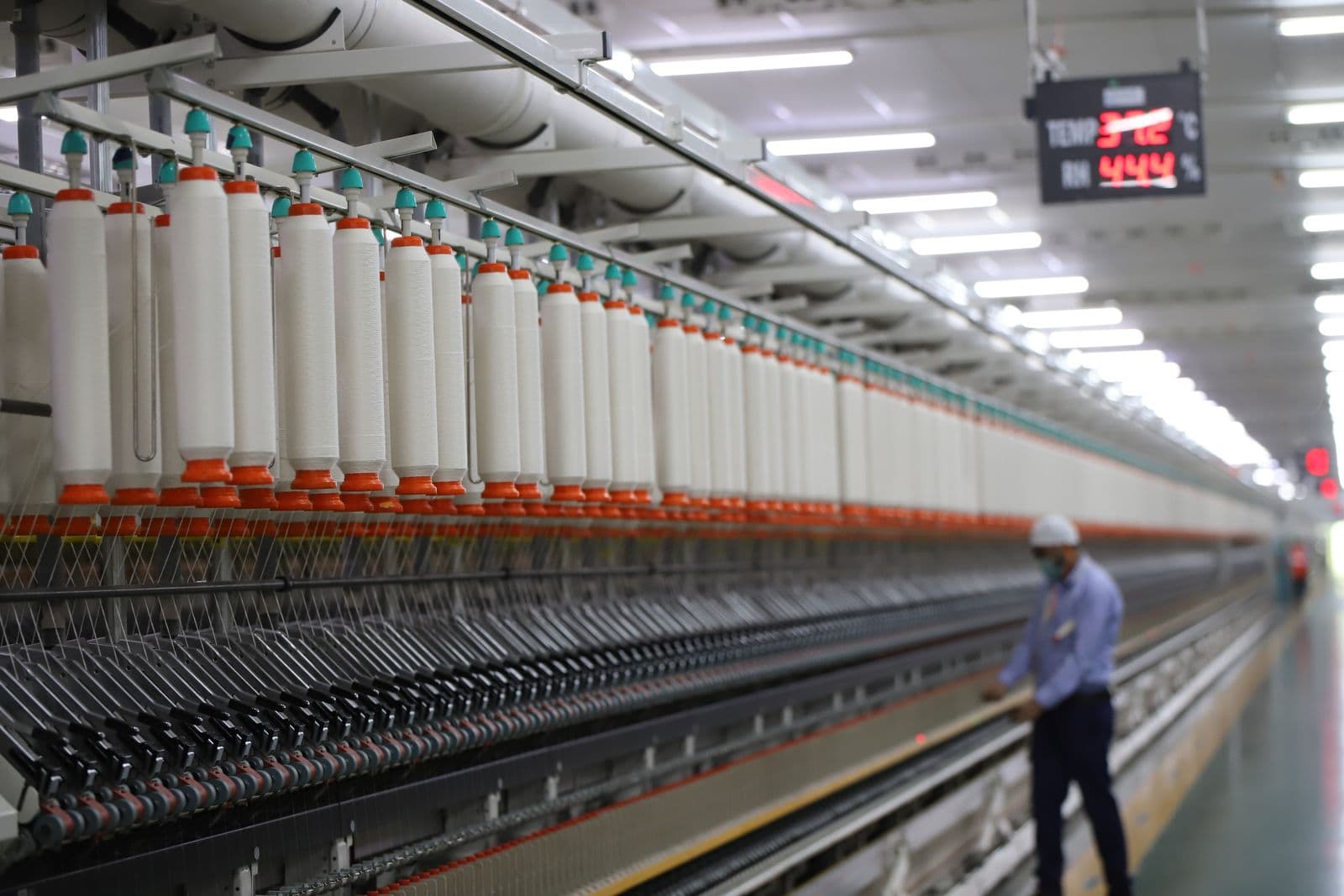
Cotton yarn (usually 20s to 40s count) on cones is loaded onto circular knitting machines, threaded through tensioners and stop motions to the needles, and knitted into tubes of fabric; flat-bed machines make sheet fabric for sweaters and scarves. Rolls are checked, marked with count and weight, and sent to garment makers or processors. The Stand-Up Mitra profile runs it as job work at ₹22–25 a kg; the older DC-MSME profile buys yarn and sells grey fabric at ₹145 a kg.
Capacity: DC-MSME: 1,60,400 kg of fabric a year worth ₹2.33 crore. Stand-Up Mitra: job-work sales of ₹40.32 L a year at full capacity (60% in year 1).
§2Is it right for you?
Who it is for
Someone in a knitting cluster such as Tiruppur, Ludhiana or Kolkata with ties to garment makers.
Who it is not for
Someone who needs profit in the first year — the job-work model loses money until capacity use passes about 80%.
Advantages
- Knitted garments are cheap and comfortable, and their use keeps growing
- Machines are available in India; skills are easy to learn
- Job work avoids buying yarn
- Export buyers source knitted fabric from India
Drawbacks
- Modern circular machines are costly (₹10–25 L each in the Stand-Up Mitra list)
- Job-work rates are thin; Stand-Up Mitra shows losses in the first two years
- Tiny local units undercut prices
- Yarn price swings hit the own-yarn model
Skills you need
- Setting and maintaining knitting machines
- Choosing yarn count, gauge and GSM
- Spotting knitting faults
- Meeting garment makers' delivery dates
Why difficulty 3/5: Simple process, but thin rates and costly modern machines make the early years hard.
§3Market
Who buys
- T-shirt, innerwear and sportswear makers
- Children's and baby wear makers
- Nightwear makers
- Fabric processors and traders
How it sells
- Job work for garment units
- Direct sale of grey fabric rolls
- Export buyers sourcing fabric from India
Good to know
- Stand-Up Mitra says most nightwear is made from knit fabric and many people wear knits on weekends.
- It warns of price competition where many knitting units are close together.
- DC-MSME says garment units were short of quality fabric, so selling on time is the key.
§4Raw material & machinery
| Item | Qty | Cost |
|---|---|---|
| Single jersey circular knitting machines | 2 | ₹20,00,000 |
| Double jersey circular knitting machines | 2 | ₹30,00,000 |
| Flat bed knitting machine | 1 | ₹25,00,000 |
| Sinker body knitting machines, 22 gauge, 17 in dia | 8 | ₹4,64,000 |
| Sinker body knitting machines, 18 gauge, 18 in dia | 8 | ₹4,80,000 |
| Sinker body knitting machines, 24 gauge, 15 in dia | 8 | ₹4,40,000 |
| Electronic weighing balance | 1 | ₹45,000 |
From: SIDBI Stand-Up Mitra project profile — Cotton Knitted Fabric (2018) — private guide — confirm locally · DC-MSME project profile — Cotton Knitted Fabrics (2003)
- Cotton hosiery yarn, 20s–40s countDC-MSME: 13,600 kg of 40s yarn a month at ₹120 a kg
- Polyester-cotton or Lycra yarn when the customer asks for it
From: DC-MSME project profile — Cotton Knitted Fabrics (2003) · SIDBI Stand-Up Mitra project profile — Cotton Knitted Fabric (2018) — private guide — confirm locally
Suppliers in Building Business Bazaar
Bombay Textiles Research Association (BTRA), Mumbai · Mumbai →Northern India Textile Research Association (NITRA), Ghaziabad · Ghaziabad →SHRIRAM INSTITUTE FOR INDUSTRIAL RESEARCH( A UNIT OF SHRIRAM SCIENTIFIC AND INDUSTRIAL RESEARCH FOUNDATION) · Delhi →MATERIAL TESTING LABORATORY LLP · New Delhi →AHMEDABAD TEXTILE INDUSTRY'S RESEARCH ASSOCIATION (ATIRA) · Ahmedabad →HTH LABORATORIES PRIVATE LIMITED · Panipat →KANHA TESTING LABS PVT. LTD. · Gurgaon →UL INDIA PRIVATE LIMITED · Gurgaon →INDIAN INSTITUTE OF CARPET TECHNOLOGY · Srinagar →TUV RHEINLAND INDIA PRIVATE LIMITED · Bengaluru →ICAR-CENTRAL INSTITUTE OF FISHERIES TECHNOLOGY, COCHIN · Kochi →MATTER MATERIAL TESTING AND RESEARCH LABORATORY PRIVATE LIMITED · Kozhikode →
In our raw material database
§5Licences & registration
- Udyam registration
- GST
- Shops and Establishment and professional tax registration with the local body
- Factory licence, EPF and ESI registration depending on workers and power
- State Pollution Control Board consent where it applies (knitting itself creates little pollution)
§6Schemes & subsidies
- CGTMSECentralActiveNo collateral, up to ₹10 crore
- Stand-Up IndiaCentralClosed₹10 lakh – ₹1 crore loan
Above the PMEGP limit in both profiles; CGTMSE covers loans without collateral, and Stand-Up India suits SC/ST or women founders (the Stand-Up Mitra profile was written for it).
§7Money
How the investment is worked out: Stand-Up Mitra profile (2018, job-work model): plant and machinery ₹76.25 L, furniture and electrical ₹3.30 L, other assets ₹1.00 L, working capital margin ₹3.26 L = ₹83.81 L. DC-MSME profile (SISI New Delhi, May 2003, own-yarn model): fixed capital ₹17.40 L (24 circular knitting machines ₹13.44 L) + working capital for 3 months ₹52.28 L = ₹69.69 L. Premises rented in both.
Working capital: Job work needs little working capital (Stand-Up Mitra: ₹5.08 L gross, margin ₹3.26 L). Buying your own yarn needs much more (DC-MSME: ₹52.28 L for 3 months; 13,600 kg of 40s yarn a month at ₹120 a kg).
Stand-Up Mitra profile 2018; the DC-MSME profile's prices are from 2003 — check current machine and yarn prices.
§8Export potential
Confirm the HS code in the DGFT ITC(HS) lookup before you export
Export council / board: TEXPROCIL (The Cotton Textiles Export Promotion Council)
- Dyed fabric falls under 6006.22 and fabric with 5% or more elastomeric yarn under heading 6004; confirm the 8-digit ITC(HS) line with DGFT.
- You need an Import Export Code (IEC) from DGFT before the first shipment.
§9Risks — where people fail
- Low machine use in slack seasons
- Price competition from small units
- Yarn price swings
- Delays and quality complaints from garment buyers
§1030 / 60 / 90-day plan
A general plan that applies to any business. A plan for this business will be added after research.
- Days 1–30: Visit a working cotton knitted (hosiery) fabric unit unit, ask 10 buyers about price and quantity, and get quotations from 3 suppliers.
- Days 31–60: Udyam and the licences you need (Udyam registration, GST), a project report (DPR), and the scheme or loan file.
- Days 61–90: Space and machines, trial production, and first deliveries to 10 customers.
§11Who to connect with
Associations, clusters and training institutes — the directory is being built. Connect
§12Watch
There is no episode on this business yet. Shows are coming soon on the Podcast page.
Want to start Cotton Knitted (Hosiery) Fabric Unit?
DPR, loan file or registration — ask us on WhatsApp.
¶Sources
- SIDBI Stand-Up Mitra project profile — Cotton Knitted Fabric (2018)
- DC-MSME project profile — Cotton Knitted Fabrics (2003)
Data review: 6 October 2026. Spotted a mistake? Report it. For information only — not legal or financial advice.