

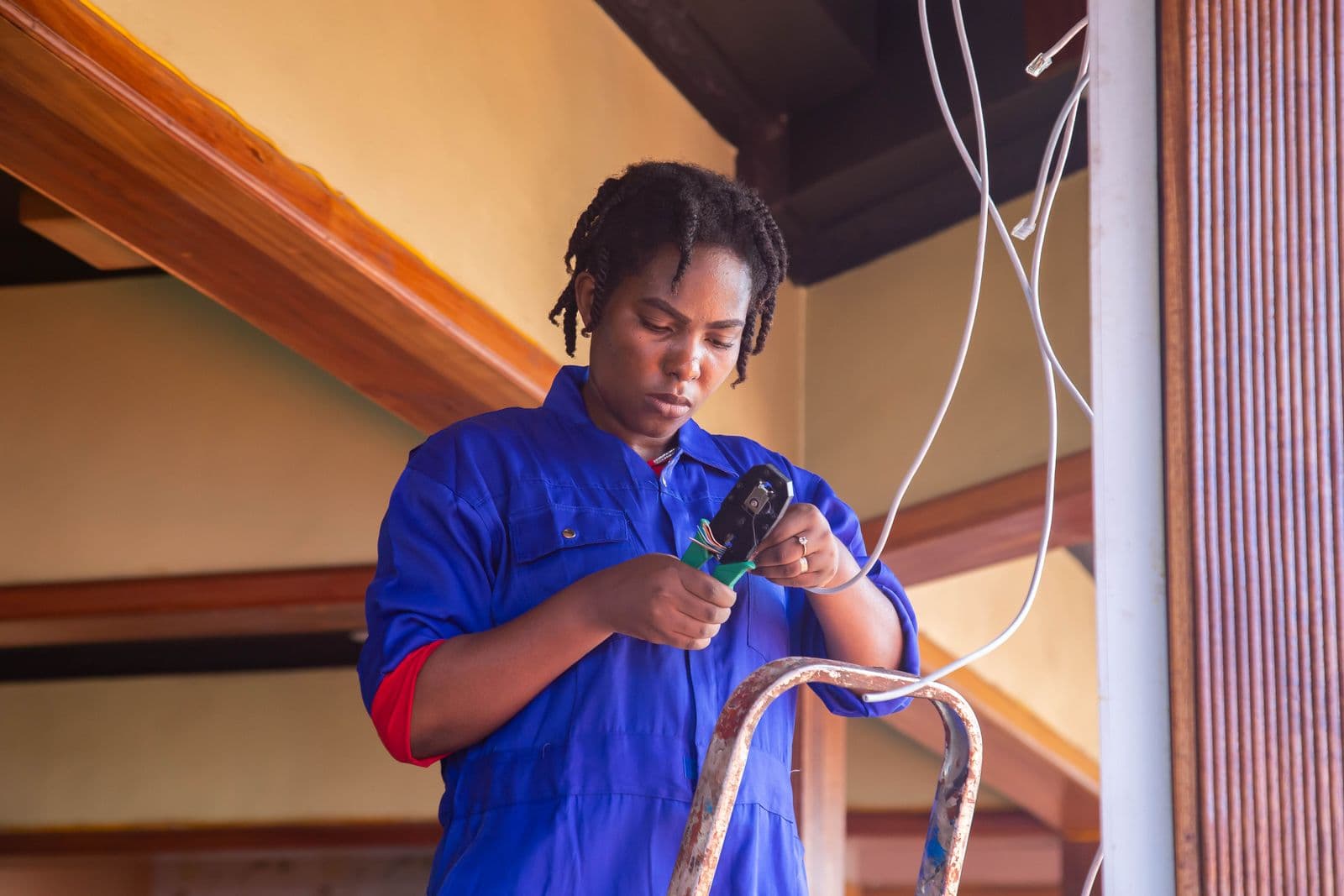
§1What this business is
A smart meter records electricity use at short intervals and sends the readings to the power company. The report's unit moulds the plastic casing, prints solder paste and places components on circuit boards (pick-and-place, reflow oven, inspection), assembles and tests about 50 meters a day.
Capacity: 50 meters a day (10-hour shift); 30% use in year 1.
§2Is it right for you?
Who it is for
An electronics engineer with links to meter companies or utility contractors.
Who it is not for
A first-time founder with no electronics or tender experience.
Advantages
- Government push to replace old meters with smart meters
- Circuit-board assembly skills carry over to other electronics
- Small floor area
- Break-even only 24% in the report
Drawbacks
- Main buyers are power companies and big contractors with strict approvals
- Chips, modems and other parts are mostly imported
- Meters must pass type tests before utilities buy
- Thin net margin (5–7%)
Skills you need
- SMT/PCB assembly
- Firmware and communication testing
- Quality systems and type testing
- Tendering and business-to-business sales
Why difficulty 4/5: Needs electronics skill, approvals and access to utility buyers.
§3Market
Who buys
- Power distribution companies (through tenders)
- Larger meter brands and smart-meter contractors (job work)
- Housing societies and commercial buildings (sub-metering)
How it sells
- Assembling for bigger meter makers
- Utility tenders after approvals
- Electrical contractors
Good to know
- The report quotes the global smart meter market at $21.13 billion in 2019, projected to reach $39.20 billion by 2027.
§4Raw material & machinery
| Item | Qty | Cost |
|---|---|---|
| Injection moulding machine | 1 | ₹7,00,000 |
| Solder paste printer | 1 | ₹1,00,000 |
| Pick-and-place machine | 1 | ₹1,50,000 |
| Single reflow oven | 1 | ₹90,000 |
| Solder paste inspection (SPI) machine | 1 | ₹1,65,000 |
| Automated optical inspection (AOI) machine | 1 | ₹4,00,000 |
| Temperature-controlled soldering station | 1 | ₹26,000 |
| Printing machine | 1 | ₹1,50,000 |
| Testing equipment | LS | ₹50,000 |
From: PMEGP sample project report — Smart Energy Meter (prepared by Udyami/Samadhan)
- PP or PVC plastic granulesfor moulding the meter casing
- Electronic parts: power converter, processor, modem, internal battery, display (LED/LCD), Hall-effect sensor, cover-tamper and tact switches, custom circuit boardthe largest cost item
- Screws, springs, solder wire and paste, flux, battery contacts, connectors, wiressmall parts bought in bulk
From: PMEGP sample project report — Smart Energy Meter (prepared by Udyami/Samadhan)
Suppliers in Building Business Bazaar
Institute for Design of Electrical Measuring Instruments (IDEMI), Mumbai · Mumbai →Electronics Service & Training Centre (ESTC), Ramnagar · Ramnagar →MSME Technology Centre, Puducherry · Puducherry →MSME Technology Centre, Greater Noida · Greater Noida →MSME Technology Centre, Bengaluru · Bengaluru →Choudhary Trading Co · Delhi →A.K. Metal Works · Delhi →Allied Glasses Pvt. Ltd · Meerut →Arun Enterprises · Ghaziabad →Auto and General Casting Pvt. Ltd · Delhi →Balaji Industries · Delhi →Bansal Industries · Delhi →
§5Licences & registration
- Udyam registration
- GST registration
- Type-test and BIS certificates that the buying utility's tender asks for
- State Pollution Control Board consent to establish and operate
§6Schemes & subsidies
- PMEGPCentralActive15–35% subsidy
- CGTMSECentralActiveNo collateral, up to ₹10 crore
- Stand-Up IndiaCentralClosed₹10 lakh – ₹1 crore loan
PMEGP (manufacturing up to ₹50 lakh), CGTMSE for a loan without collateral, Stand-Up India for SC/ST or women founders. Above MUDRA's ₹20 lakh limit.
§7Money
How the investment is worked out: Samadhan report: plant & machinery ₹18.31 L, furniture ₹0.60 L, working capital ₹6.04 L = ₹24.95 L (term loan ₹17.02 L, cash credit ₹5.43 L, own money ₹2.49 L). Land own or rented.
Working capital: Working capital ₹6.04 L (cash credit ₹5.43 L); 10 days of stock, 7 days' credit to buyers, 12 days' credit from suppliers.
Year not printed on the report — check current machinery and material prices.
§8Export potential
Confirm the HS code in the DGFT ITC(HS) lookup before you export
Export council / board: Electronics and Computer Software Export Promotion Council (ESC)
- Get an Import Export Code (IEC) from DGFT before exporting.
- Each country's utilities set their own meter standards and certification.
§9Risks — where people fail
- Utility tenders favour large approved makers
- Component shortages and price swings
- Failing type tests
- Long payment cycles
§1030 / 60 / 90-day plan
A general plan that applies to any business. A plan for this business will be added after research.
- Days 1–30: Visit a working smart energy meter assembly unit, ask 10 buyers about price and quantity, and get quotations from 3 suppliers.
- Days 31–60: Udyam and the licences you need (Udyam registration, GST registration), a project report (DPR), and the scheme or loan file.
- Days 61–90: Space and machines, trial production, and first deliveries to 10 customers.
§11Who to connect with
Associations, clusters and training institutes — the directory is being built. Connect
§12Watch
There is no episode on this business yet. Shows are coming soon on the Podcast page.
Want to start Smart Energy Meter Assembly?
DPR, loan file or registration — ask us on WhatsApp.
¶Sources
Data review: 6 October 2026. Spotted a mistake? Report it. For information only — not legal or financial advice.