

§1What this business is
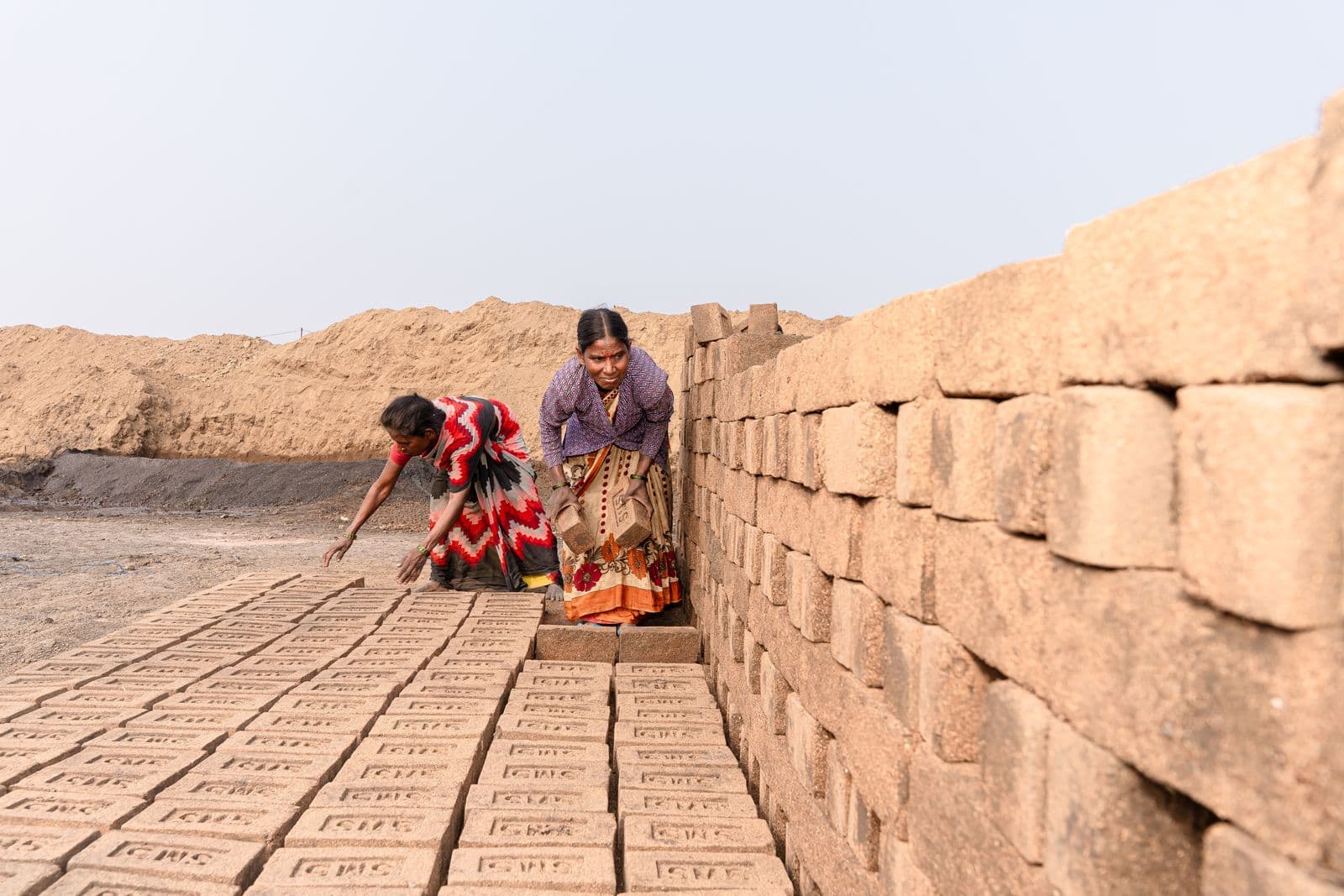
Soil is tested, dried and sieved, mixed with cement and water, pressed into blocks and water-cured for about three weeks. The blocks replace burnt clay bricks in low-cost housing and are about 2½ times bigger, so walls go up faster with less mortar. The report makes 2,400 blocks a day and sells them at ₹10 each; standard IS 1725.
Capacity: 2,400 blocks a day, 7,20,000 a year (one shift, 300 days); 60% in year 1.
§2Is it right for you?
Who it is for
Someone with open land near growing villages or towns and links to builders or housing schemes.
Who it is not for
Someone without suitable soil or space for curing.
Advantages
- No firing — saves fuel and avoids kiln smoke
- Local soil is the main raw material
- Government agencies promote it for low-cost housing
- Bigger blocks mean faster walls and less mortar
Drawbacks
- Builders and masons still prefer burnt bricks in many areas
- Not for isolated load-bearing columns or heavily loaded parts (report)
- Needs big open land and three weeks of curing
- Cement price rises hit the margin
Skills you need
- Soil testing and mix design
- Curing discipline
- Selling to builders and government housing
- Teaching masons to use the blocks
Why difficulty 2/5: Simple process; selling against burnt bricks takes effort.
§3Market
Who buys
- Government and rural housing schemes
- Builders and contractors
- Families building their own homes
How it sells
- Direct sale from the yard
- Supply to housing projects
- Building-material dealers
Good to know
- Selling price ₹10 a block in the report (29 × 19 × 9 cm size).
- Technical guidance: Centre for Sustainable Technologies (IISc Bangalore) and Development Alternatives, New Delhi (report).
§4Raw material & machinery
| Item | Qty | Cost |
|---|---|---|
| Hydraulic block-making machine with 15 HP motor | 1 | ₹8,00,000 |
| Concrete mixer, 10/7 cft, with 5 HP motor | 1 | ₹1,50,000 |
| Water dosing pump | 1 | ₹50,000 |
| Electricals and power-connection charges for 25 HP | LS | ₹1,00,000 |
From: PMEGP sample project report — Soil Cement Blocks (prepared by Udyami/Samadhan)
- Soil or raw earth4,800 MT a year at ₹150 per MT (full capacity); about 75% sand and 25% silt and clay is best (report)
- Cement (ordinary Portland)360 MT a year at ₹5,800 per MT
- Sand or crushed stone dust2,400 MT a year at ₹300 per MT
- Waterclean, fit-to-drink quality is adequate (report)
From: PMEGP sample project report — Soil Cement Blocks (prepared by Udyami/Samadhan)
In our raw material database
§5Licences & registration
- Udyam registration
- GST registration
- State Pollution Control Board consent to establish and operate
- Permission for digging soil if required under state minor-mineral rules
- Testing to IS 1725 for government buyers
§6Schemes & subsidies
- PMEGPCentralActive15–35% subsidy
- CGTMSECentralActiveNo collateral, up to ₹10 crore
- Stand-Up IndiaCentralClosed₹10 lakh – ₹1 crore loan
PMEGP (the report is a PMEGP sample), CGTMSE, Stand-Up India for SC/ST or women founders. Above MUDRA's ₹20 lakh limit.
§7Money
How the investment is worked out: Samadhan report: covered area (50 sq m) ₹2.00 L, brick-curing platform (250 sq m) ₹1.50 L, borewell with pump ₹0.75 L, plant & machinery ₹11.00 L, furniture ₹0.75 L, pre-operative ₹0.35 L, working capital ₹6.34 L = ₹22.69 L (term loan ₹14.72 L, working capital ₹5.71 L, own money ₹2.27 L); land 2,000 sq m own or rented.
Working capital: Working capital ₹6.34 L (bank ₹5.71 L); 30 days of raw material and finished blocks in stock.
Year not printed on the report — check current machinery and material prices.
§8Export potential
Not an export product — blocks are heavy and sold within a short distance.
§9Risks — where people fail
- Weak blocks from poor soil or curing
- Slow acceptance by masons
- Cement price swings
- Seasonal construction slowdowns (monsoon)
§1030 / 60 / 90-day plan
A general plan that applies to any business. A plan for this business will be added after research.
- Days 1–30: Visit a working soil cement blocks (stabilised mud blocks) unit, ask 10 buyers about price and quantity, and get quotations from 3 suppliers.
- Days 31–60: Udyam and the licences you need (Udyam registration, GST registration), a project report (DPR), and the scheme or loan file.
- Days 61–90: Space and machines, trial production, and first deliveries to 10 customers.
§11Who to connect with
Associations, clusters and training institutes — the directory is being built. Connect
§12Watch
There is no episode on this business yet. Shows are coming soon on the Podcast page.
Want to start Soil Cement Blocks (Stabilised Mud Blocks)?
DPR, loan file or registration — ask us on WhatsApp.
¶Sources
Data review: 6 October 2026. Spotted a mistake? Report it. For information only — not legal or financial advice.