

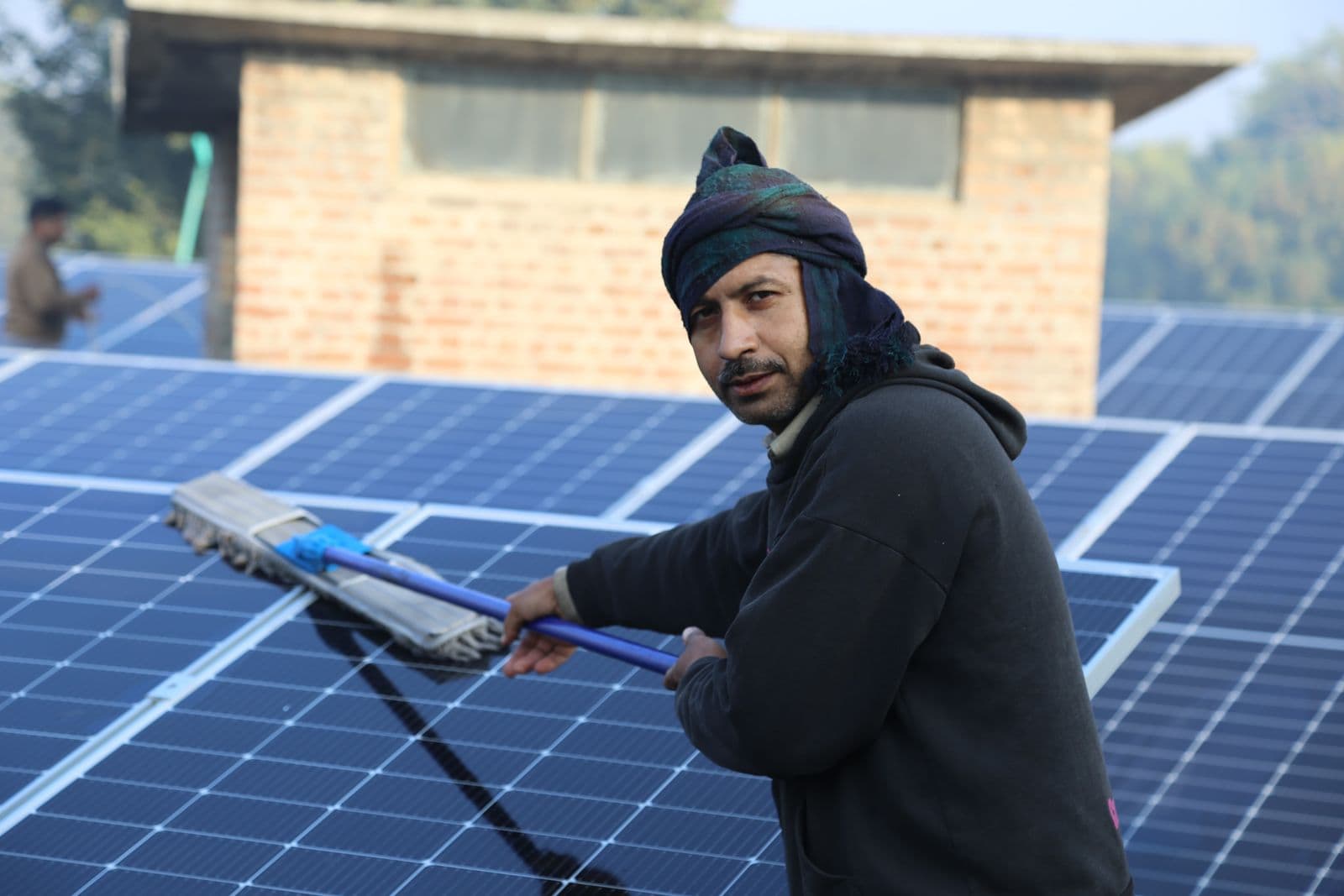
§1What this business is
Bought-in parts — solar panels, batteries, charge-controller and inverter boards, LED or CFL lamps, cabinets and poles — are checked, soldered and wired, fitted into cabinets and tested for output voltage, current and light before packing. A street-light set has a panel, battery box, lamp with controller and a pole; a home-light set adds a DC fan. Two DC-MSME profiles describe this work at very different sizes; both still list CFL lamps.
Capacity: Solar Items: 3,000 solar LED lanterns, 1,200 LED street lights (37 W), 3,000 solar inverters and 1,500 solar street lights (75 W) a year. Solar Light Systems: rated 24,000 each of lanterns, street-light systems and home-light systems a year; its sales are worked out on 12,000 of each.
§2Is it right for you?
Who it is for
An electronics or electrical engineer with contacts among government buyers, contractors and solar dealers.
Who it is not for
Someone with little capital — one month of panels and batteries costs far more than the machinery.
Advantages
- Steady demand from panchayats, municipalities and rural homes with weak grid power
- Assembly and testing — no heavy machinery
- Products can be sold under your own brand
- Can start with lanterns and add street lights later
Drawbacks
- Thin margins of 3–5% in both profiles
- Very large working capital for panels and batteries
- Big brands and imported products compete on price
- Much of the market is government tenders with specifications and delayed payment
Skills you need
- Charge controller and inverter circuits
- Battery and panel sizing
- Testing to MNRE/BIS specifications
- Tender paperwork and dealer sales
Why difficulty 4/5: Simple assembly, but huge working capital, thin margins and tender selling make it hard.
§3Market
Who buys
- Gram panchayats, municipalities and state nodal agencies (street lights)
- Rural homes without steady grid power
- Dairy milk-collection and chilling centres in villages (profile)
- Campuses, farms and housing colonies
How it sells
- Government and agency tenders
- Solar dealers and electrical shops
- Direct sale to contractors and institutions
Good to know
- The Solar Light Systems profile says home systems are useful in non-electrified villages and as emergency lighting.
- Street-light batteries are sized to run the lamp 10–11 hours a night with automatic dusk-to-dawn switching (profile).
§4Raw material & machinery
| Item | Qty | Cost |
|---|---|---|
| Dies for lantern, home light, street light and inverter cabinets | 1 set | ₹3,75,000 |
| Press-cum-bending machine | 2 | ₹80,000 |
| Drying oven (0–300 °C) | 1 | ₹50,000 |
| Dip-soldering machine | 2 | ₹40,000 |
| Temperature-controlled soldering stations | 6 | ₹36,000 |
| Digital panel (volt/amp) meters | 2 | ₹40,000 |
| Digital true-RMS multimeters, 3½ digit | 2 | ₹30,000 |
| Digital multimeters, 4½ digit | 2 | ₹20,000 |
| Welding machine, 200 A | 1 | ₹20,000 |
| Grinding machine, 100 mm | 2 | ₹20,000 |
| Motorised drilling machines | 2 | ₹12,000 |
| Painting booth with paint gun | 1 | ₹1,00,000 |
| Oven | 1 | ₹50,000 |
| 30 MHz oscilloscope | 1 | ₹25,000 |
| Harmonic distortion meter | 1 | ₹15,000 |
| High-voltage tester | 1 | ₹8,000 |
| Earthing, insulation-resistance and leakage-current testers | 3 | ₹12,000 |
From: DC-MSME project profile — Solar Items (Solar LED Lantern, Solar LED Street Light, Solar CFL Inverter & Solar CFL Street Light) (MSME-DI New Delhi) (2021) · DC-MSME project profile — Solar Light Systems (MSME-DI New Delhi) (2021)
- Solar panelsthe largest cost: ₹75 L a month for 3,000 PV modules in the larger profile; ₹4,000 (street light) to ₹8,000 (75 W street light) each in the smaller one
- Batteries₹14 L a month for 3,000 in the larger profile; ₹220 (lantern) to ₹8,000 (75 W street light) each in the smaller one
- Charge-controller and inverter circuit boards₹2 L and ₹30 L a month in the larger profile
- Poles, battery boxes and panel stands₹2,100 per street-light set
- LEDs with heat sinks, CFLs, cabinets, switches, wires, DC fansbought locally
From: DC-MSME project profile — Solar Light Systems (MSME-DI New Delhi) (2021) · DC-MSME project profile — Solar Items (Solar LED Lantern, Solar LED Street Light, Solar CFL Inverter & Solar CFL Street Light) (MSME-DI New Delhi) (2021)
Suppliers in Building Business Bazaar
Access Solar Ltd · Hyderabad →Aplab Limited · Secunderabad →Automatic Electric Co. Ltd · Mumbai →Automatic Electric Limited · Secunderabad →BEL Abids · Hyderabad →Bergen Associates Pvt. Ltd · Chandigarh →Bharat Electronics Ltd · Bengaluru →BHEL Ltd · Delhi →Cosmic Engineering Enterprises · Hyderabad →Electromagnetic Cores and Coils · Hyderabad →Kotak Pvt. Ltd · Kota →Motor Industries Co. Ltd. (Bosch Group-Power Tools) · Secunderabad →
§5Licences & registration
- Udyam
- GST
- BIS registration for products and parts under the Compulsory Registration Scheme (solar modules, batteries, LED items — check the current list)
- MNRE specification test reports for government tenders
- Battery and e-waste EPR registration where it applies
- Pollution board consent if your state asks for it
§6Schemes & subsidies
- CGTMSECentralActiveNo collateral, up to ₹10 crore
- Stand-Up IndiaCentralClosed₹10 lakh – ₹1 crore loan
- PMEGPCentralActive15–35% subsidy
CGTMSE and Stand-Up India suit both sizes. PMEGP covers manufacturing projects only up to ₹50 lakh, so only a smaller start fits it.
§7Money
How the investment is worked out: Solar Items profile: fixed capital ₹17.98 L (shed ₹5 L on own land, machinery and dies ₹7.71 L, tools, office and electrification ₹4.27 L, pre-operative ₹1 L) + 1 month working capital ₹47.22 L = ₹65.20 L. Solar Light Systems profile: fixed capital ₹5.53 L (test equipment and paint booth ₹2.30 L, other fixed assets ₹3.23 L) + 3 months working capital ₹4.06 crore = ₹4.11 crore. Raw material (panels, batteries, circuits) is most of the money.
Working capital: Raw material is ₹46.37 L a month in the smaller profile and ₹1.33 crore a month in the larger — panels and batteries alone are most of it. Government buyers often pay late, so this money gets locked up.
Both profiles are dated 2020-21, but the first says its wages are 2009-10 Cuttack rates and its machine prices 2006-07, and both still use CFL lamps — check current prices and LED specifications.
§8Export potential
Confirm the HS code in the DGFT ITC(HS) lookup before you export
Export council / board: DGFT (IEC needed)
- Confirm the 8-digit ITC(HS) line with DGFT or your customs broker.
- You need an Import Export Code (IEC) from DGFT before the first shipment.
§9Risks — where people fail
- Battery failures and warranty claims
- Price swings in panels and batteries
- Late payment from government buyers
- Specifications changing (CFL to LED, new battery types)
§1030 / 60 / 90-day plan
A general plan that applies to any business. A plan for this business will be added after research.
- Days 1–30: Visit a working solar street light and home lighting system assembly unit, ask 10 buyers about price and quantity, and get quotations from 3 suppliers.
- Days 31–60: Udyam and the licences you need (Udyam, GST), a project report (DPR), and the scheme or loan file.
- Days 61–90: Space and machines, trial production, and first deliveries to 10 customers.
§11Who to connect with
Associations, clusters and training institutes — the directory is being built. Connect
§12Watch
There is no episode on this business yet. Shows are coming soon on the Podcast page.
Want to start Solar Street Light and Home Lighting System Assembly?
DPR, loan file or registration — ask us on WhatsApp.
¶Sources
- DC-MSME project profile — Solar Items (Solar LED Lantern, Solar LED Street Light, Solar CFL Inverter & Solar CFL Street Light) (MSME-DI New Delhi) (2021)
- DC-MSME project profile — Solar Light Systems (MSME-DI New Delhi) (2021)
Data review: 6 October 2026. Spotted a mistake? Report it. For information only — not legal or financial advice.