

§1What this business is
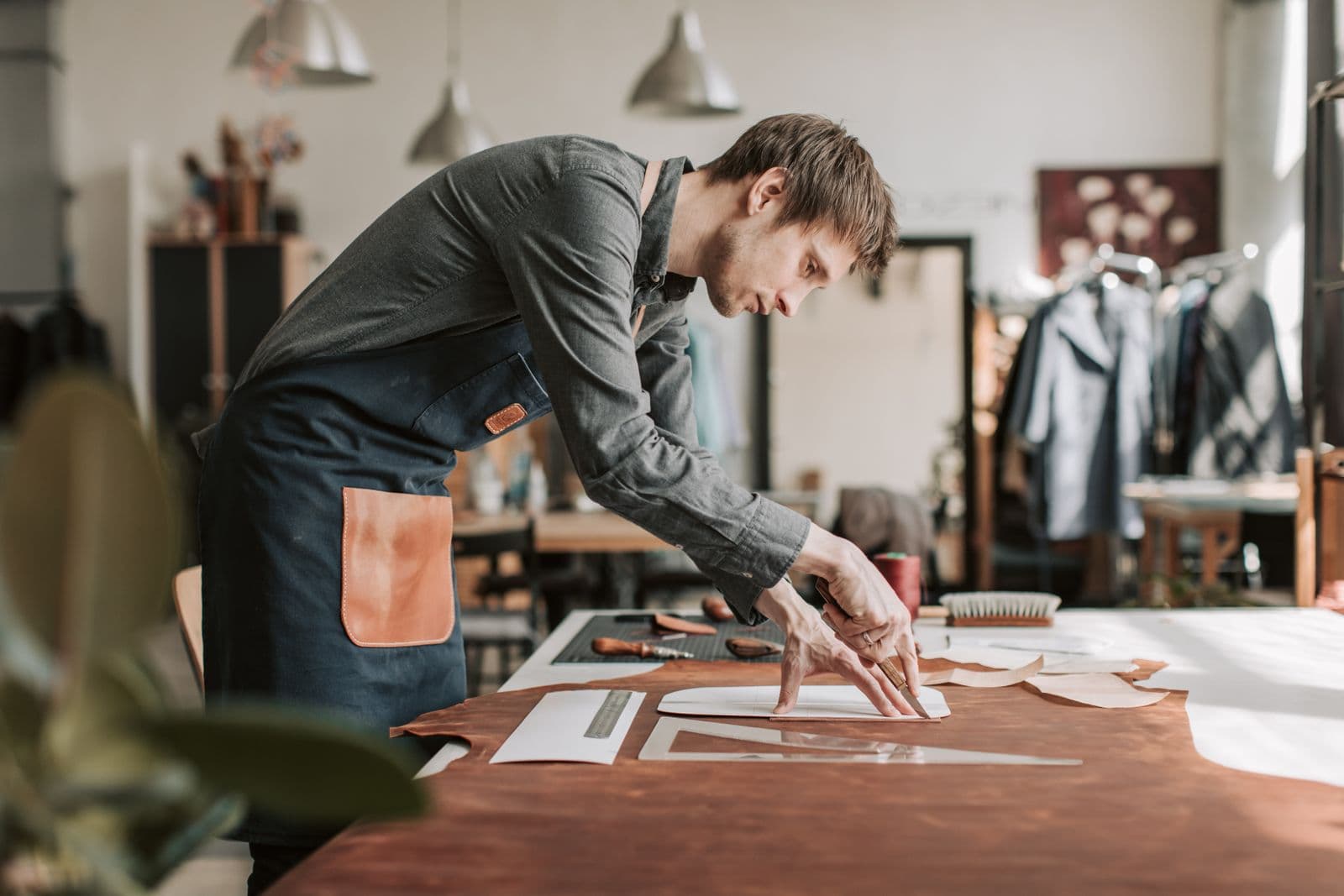
Artistic leather goods — also called Santiniketani leather goods — come mainly from Santiniketan and other places in Birbhum district of West Bengal, and from a few other districts including Kolkata. What sets them apart is the art work: designs are embossed on the leather by machine or by hand and then coloured. Patterns are laid out and components are cut from E.I. tanned goat leather, skived where needed, decorated, pasted to the lining, assembled and stitched. Extra lining is trimmed, the article is turned inside out, fittings are attached, colour is applied and the piece is polished, finished, stamped with the brand, inspected and packed. The profile plans five products: shopping bags, ladies' vanity bags, ladies' purses, gents' wallets and jewellery cases. There is no specific BIS standard for wallets and purses; goods are made to the buyer's sample, and hand-stitching quality matters most.
Capacity: A year: 3,000 shopping bags, 6,000 ladies' vanity bags, 18,000 ladies' purses, 18,000 gents' wallets and 3,000 jewellery cases, valued at ₹85.20 lakh.
§2Is it right for you?
Who it is for
A craft entrepreneur or artisan group with trained embossing and stitching workers and links to craft emporia or export buyers.
Who it is not for
Someone who wants to sell on price alone; this product sells on design and finish.
Advantages
- A distinct craft look that plain leather goods do not have
- The profile names export markets: USA, Japan, Great Britain, Brazil, Canada and Italy
- Labour-based work with only 5 HP of power
- The same unit can also make school bags, travel bags and pouches
Drawbacks
- Needs 29 people, including trained craft workers and a designer
- High break-even of 59.57%
- Export buyers set strict rules on sample, colour and stitching
- The costly cylinder-bed sewing machines are ₹6 lakh of the ₹9.97 lakh equipment
Skills you need
- Leather cutting, skiving and hand stitching
- Embossing and hand colouring of designs
- Pattern making and new designs
- Meeting export samples and quality checks
Why difficulty 3/5: Light machinery, but it needs skilled craft workers, design sense and exacting buyers.
§3Market
Who buys
- Craft emporia and handicraft shops
- Gift and fashion-accessory retailers
- Export buying houses
- Tourists and visitors at craft centres
How it sells
- Supply to emporia and retailers
- Export orders made to the buyer's sample
- Craft fairs and exhibitions
Good to know
- Selling prices in the profile: shopping bag ₹600, vanity bag ₹560, jewellery case ₹190, ladies' purse ₹75, gents' wallet ₹70.
- The profile names the USA, Japan, Great Britain, Brazil, Canada and Italy as the main export markets.
§4Raw material & machinery
| Item | Qty | Cost |
|---|---|---|
| Ball press | 2 | ₹30,000 |
| Flat-bed single-needle sewing machine with motor | 2 | ₹20,000 |
| Cylinder-bed sewing machine | 2 | ₹6,00,000 |
| Board-cutting machine | 2 | ₹45,000 |
| Glazing machine | 2 | ₹1,00,000 |
| Skiving machine | 2 | ₹70,000 |
| Mini compressor | 1 | ₹5,000 |
| Zinc blocks for design embossing | — | ₹5,000 |
| Wooden vat for washing | — | ₹10,000 |
| Tools and equipment | — | ₹3,000 |
| Furniture and equipment | — | ₹22,000 |
From: DC-MSME project profile — Artistic Leather Goods (2010)
- E.I. tanned goat leather5,750 sq ft a month across the five products, at ₹40–52 per sq ft
- Lining cloth (silk, poplin and plain lining)425 m a month at ₹60–100 a metre
- Dye and spiritcosted per piece
- Thread and adhesivecosted per piece
- Fittings — zips, buttons, D and O rings, locks, decorative fittingscosted per piece
- Paper board and packingpaper board 10 kg a month at ₹100 a kg for shopping bags
From: DC-MSME project profile — Artistic Leather Goods (2010)
§5Licences & registration
- Udyam registration
- GST registration
- Trade licence from the local body
- NOC from the State Pollution Control Board (the profile asks for it)
- IEC code and Council for Leather Exports membership if you export
Start it in your state
Pick your state: today’s cost, central + state subsidy, raw material, land and help, on one page.
§6Schemes & subsidies
At ₹28.37 lakh the project is within PMEGP's ₹50 lakh ceiling for manufacturing; CGTMSE can cover the bank loan without collateral.
§7Money
How the investment is worked out: Fixed capital ₹11,10,000 (machinery and equipment with electrification ₹9,97,000; pre-operative ₹1,13,000; the shed is rented) + working capital for 3 months ₹17,26,500 = ₹28,36,500.
Working capital: Recurring cost ₹5,75,500 a month, of which leather, lining, dyes and fittings are ₹3,65,500 and salaries ₹1,83,000; working capital for 3 months ₹17,26,500.
Prices from 2010-11 — machinery, leather and wage costs will be much higher now.
§8Export potential
Confirm the HS code in the DGFT ITC(HS) lookup before you export
Export council / board: Council for Leather Exports (CLE)
- For export the profile says most makers follow the buyer's specification — sample, design, leather thickness and quality, colour, workmanship and thread.
- Confirm the 8-digit ITC(HS) line with DGFT or your customs broker before shipping.
§9Risks — where people fail
- Trained craft workers leaving
- Export orders rejected for colour or stitching faults
- Rise in goat leather prices
- Cheaper printed synthetic copies
§1030 / 60 / 90-day plan
A general plan that applies to any business. A plan for this business will be added after research.
- Days 1–30: Visit a working artistic leather goods (santiniketan-style embossed bags and purses) unit, ask 10 buyers about price and quantity, and get quotations from 3 suppliers.
- Days 31–60: Udyam and the licences you need (Udyam registration, GST registration), a project report (DPR), and the scheme or loan file.
- Days 61–90: Space and machines, trial production, and first deliveries to 10 customers.
§11Who to connect with
§12Watch
There is no episode on this business yet. Shows are coming soon on the Podcast page.
Want to start Artistic Leather Goods (Santiniketan-Style Embossed Bags and Purses)?
DPR, loan file or registration — ask us on WhatsApp.
¶Sources
Data review: 6 October 2026. Spotted a mistake? Report it. For information only — not legal or financial advice.