

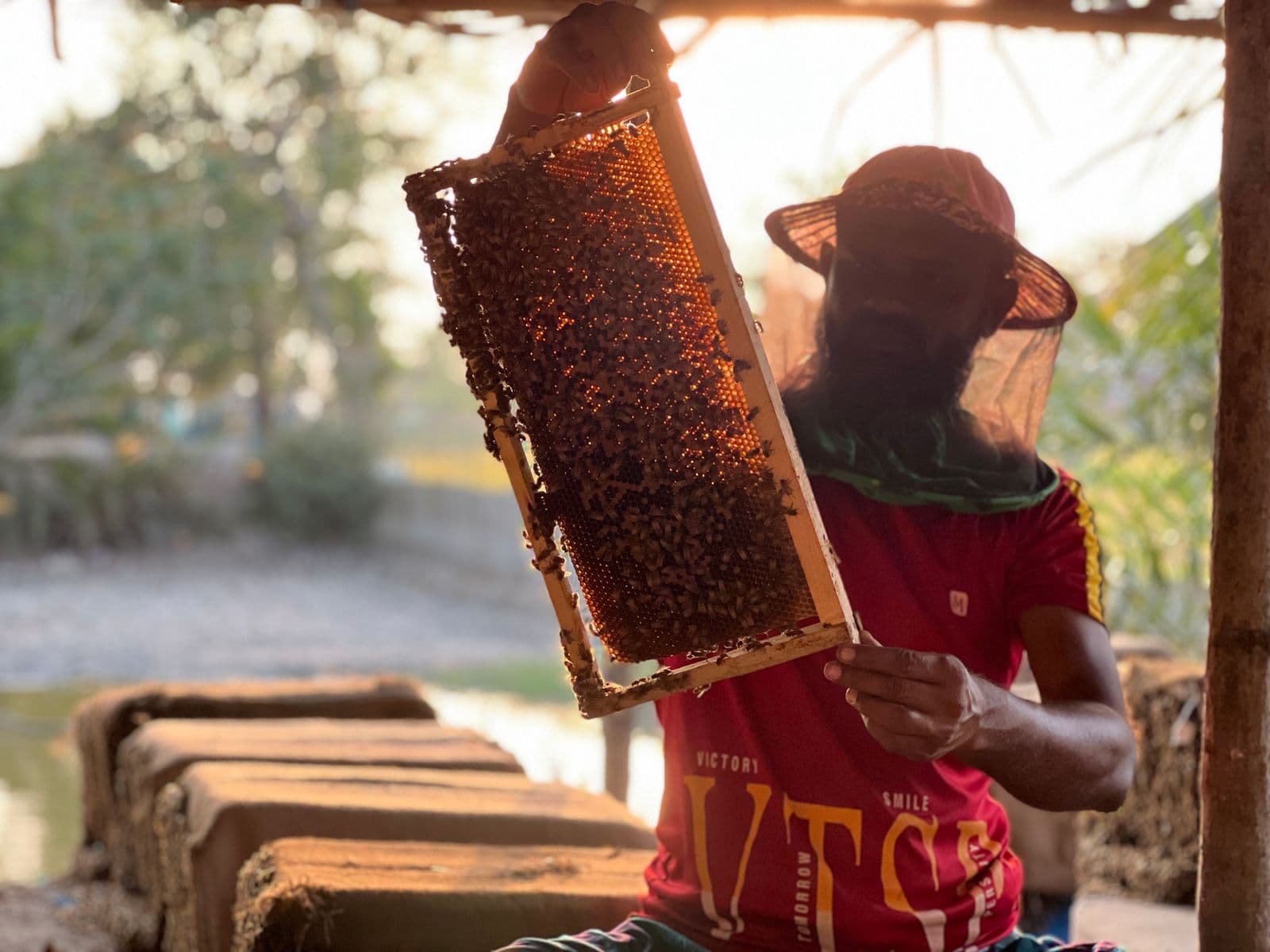
§1What this business is
Raw honey from beekeepers is received in steel tanks, filtered, warmed, reduced in moisture so it does not ferment, stored in jacketed tanks and filled into jars, bottles or pouches. Processed honey is sold to households, and in bulk to pharmaceutical, Ayurvedic, confectionery and bakery makers. India also exports honey; the Samadhan report quotes APEDA data of 51,547 tonnes worth ₹653.58 crore in 2017-18.
Capacity: KVIC: 31,550 kg of honey a year. Samadhan: 500 kg a day, 1,50,000 kg a year; year 1 at 40%.
§2Is it right for you?
Who it is for
Someone with links to beekeepers or a beekeeping cluster, and buyers in pharma, food or export.
Who it is not for
Someone who cannot afford proper testing or wants to sell unbranded loose honey.
Advantages
- Honey demand is rising as a health food
- Pharma, Ayurveda and confectionery buy in bulk
- Export market for tested, residue-free honey
- Supports local beekeepers
Drawbacks
- Adulteration scandals make buyers wary — testing is essential
- Raw honey supply and price vary by season
- Big brands dominate retail shelves
- Large working capital for buying honey in season
Skills you need
- Honey quality testing (moisture, adulteration)
- Processing and hygiene
- Sourcing from beekeepers
- Brand and bulk sales
Why difficulty 3/5: Processing is simple; sourcing pure honey and selling on trust are the real work.
§3Market
Who buys
- Households through shops and online
- Pharmaceutical and Ayurvedic makers (cough syrups, tonics)
- Confectionery, bakery and beverage makers
- Exporters
How it sells
- Retail jars under own brand
- Bulk supply to industry
- Export through APEDA-registered exporters
Good to know
- The Samadhan report cites APEDA: 51,547.31 tonnes of natural honey exported in 2017-18, worth ₹653.58 crore; main buyers USA, Saudi Arabia, UAE, Canada, Qatar.
- It says most honey used in India goes to the pharma and confectionery industries.
§4Raw material & machinery
| Item | Qty | Cost |
|---|---|---|
| Honey processing plant, SS storage tank, bottling unit and QC lab (total) | — | ₹12,00,000 |
| Receiving SS 304 tank, 750 litre, with 3 HP stirrer | 2 | ₹8,74,000 |
| Primary filter, SS 304, 25 litre | 1 | ₹56,000 |
| Gear pump with 5 HP motor, 130 LPM | 1 | ₹95,000 |
| Dual bag filter, SS 304, 100 micron | 1 | ₹1,57,000 |
| Moisture reduction tank with heating chamber and 7.5 HP blowers | 1 | ₹9,65,000 |
| Jacketed storage tank, SS 304, 1,500 litre | 2 | ₹6,16,000 |
| Modular frame (MS) | 1 | ₹95,000 |
| Hot water boiler (wood fired) | 1 | ₹1,57,000 |
| Semi-automatic piston filling machine with 3 HP air compressor | 1 | ₹3,47,000 |
| Other equipment and hand tools | lot | ₹50,000 |
From: KVIC Project Profile — Honey Processing Plant & Honey House (PMEGP) · PMEGP sample project report — Honey Processing (prepared by Udyami/Samadhan)
- Raw honey1,57,500 kg a year at ₹150/kg at full capacity (Samadhan report)
- Chemicals and consumables₹1.00 L a year lump sum
- Bottles, lids and labels₹5.00 L a year lump sum
- Raw honey (KVIC)₹15.00 L a year in the KVIC profile, plus ₹1.00 L for sugar feeding, migration and disease control
From: PMEGP sample project report — Honey Processing (prepared by Udyami/Samadhan) · KVIC Project Profile — Honey Processing Plant & Honey House (PMEGP)
Suppliers in Building Business Bazaar
Alipurduar Honey & Areca Leaf Cluster · Alipurduar →Ankola Beekeeping Cluster · Uttar Kannad →Anmol Beekeeping Cluster · Hanumangarh →Banihal Bee Keeping Cluster · Ramban →Baroli Beekeeping Cluster · Sawai Madhopur →Bee Keeping And Honey Processing Cluster · Barabanki →Bee Keeping And Medicinal Herbal Processing And Value Addition Cluster · Shravasti →Bee Wax & Honey Processing Cluster · Nayagarh →Beed Banjara Handicraft Cluster · Beed →Beekeeping Cluster Imphal West · Imphal West →Beekeeping Cluster Kota · Kota →Bharatpur Bee Keeping Cluster · Bharatpur →
In our raw material database
§5Licences & registration
- FSSAI licence
- Udyam
- GST
- Legal Metrology packaged commodity registration
- State pollution board consent (the Samadhan report lists the NOC)
- AGMARK grading (optional)
- APEDA registration and IEC for export
§6Schemes & subsidies
- PMFMECentralUnclear35% subsidy, up to ₹10 lakh
- PMEGPCentralActive15–35% subsidy
- CGTMSECentralActiveNo collateral, up to ₹10 crore
- Stand-Up IndiaCentralClosed₹10 lakh – ₹1 crore loan
- MudraCentralActiveLoan up to ₹20 lakh, no collateral
Food processing: PMFME fits; PMEGP covers both (₹18 L and ₹46.73 L, under ₹50 L); CGTMSE for collateral-free loans; MUDRA for the KVIC-size unit; Stand-Up India for SC/ST or women founders.
§7Money
How the investment is worked out: KVIC profile ₹18.00 L: building shed 1,000 sq ft ₹3.00 L, equipment ₹12.00 L (honey processing plant, SS storage tank, bottling unit, QC lab), working capital ₹3.00 L. Samadhan report ₹46.73 L: plant & machinery ₹34.12 L, furniture ₹1.50 L, working capital ₹11.11 L; premises own or rented.
Working capital: ₹3.00 L (KVIC) to ₹11.11 L (Samadhan, bank ₹10.00 L); raw honey is most of the cost.
Year not printed on either report — check current machinery prices.
§8Export potential
Confirm the HS code in the DGFT ITC(HS) lookup before you export
Export council / board: APEDA
- Honey exports need APEDA registration and residue testing; check the 8-digit code in the DGFT ITC-HS list.
§9Risks — where people fail
- Adulteration or quality failure
- Poor flowering season cutting supply
- Price competition from large brands
- Export residue rejections
§1030 / 60 / 90-day plan
A general plan that applies to any business. A plan for this business will be added after research.
- Days 1–30: Visit a working honey processing and bottling plant unit, ask 10 buyers about price and quantity, and get quotations from 3 suppliers.
- Days 31–60: Udyam and the licences you need (FSSAI licence, Udyam), a project report (DPR), and the scheme or loan file.
- Days 61–90: Space and machines, trial production, and first deliveries to 10 customers.
§11Who to connect with
Associations, clusters and training institutes — the directory is being built. Connect
§12Watch
There is no episode on this business yet. Shows are coming soon on the Podcast page.
Want to start Honey Processing and Bottling Plant?
DPR, loan file or registration — ask us on WhatsApp.
¶Sources
- KVIC Project Profile — Honey Processing Plant & Honey House (PMEGP)
- PMEGP sample project report — Honey Processing (prepared by Udyami/Samadhan)
Data review: 6 October 2026. Spotted a mistake? Report it. For information only — not legal or financial advice.