

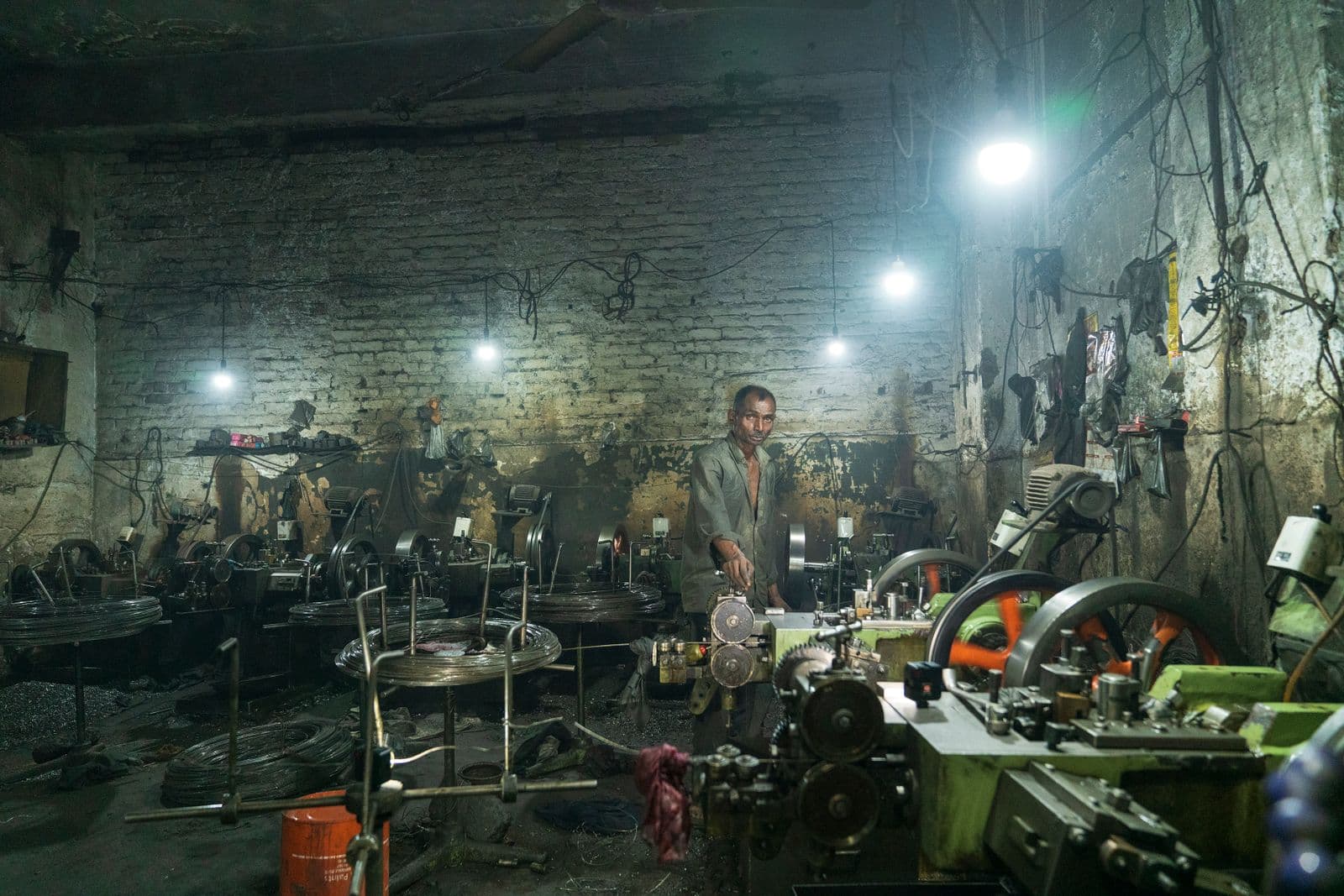
§1What this business is
A machine vice is bolted to the table of a milling or drilling machine and grips the job between a fixed and a movable jaw. The unit buys grey cast-iron castings for the body, EN-8 rod for the screw and carbon-steel plate for the jaws. The base is milled and scraped, jaw plates are drilled and tapped, screws and nuts are turned on a lathe, and the parts are ground, inspected and assembled. The profile covers plain and swivel vices of 125, 160 and 200 mm to IS 4502-1968.
Capacity: The production table lists 160 vices — 80 plain and 80 swivel in 125, 160 and 200 mm sizes — worth ₹8.40 L; the yearly turnover used in the profile is ₹1.008 crore.
§2Is it right for you?
Who it is for
A tool-room or machine-shop owner who wants a standard product to sell to machine-tool makers and dealers.
Who it is not for
A beginner without machining experience or without access to a large loan.
Advantages
- Every workshop with a milling or drilling machine needs vices
- Machine-tool makers give vices out to small units as sub-contract work
- Castings and steel are available in all industrial towns
- Six sizes and types sell from one set of machines
Drawbacks
- Large outlay of ₹87.47 L, with ₹50 L in land and building
- Accuracy matters — bases must be milled, scraped and ground true
- Interest alone is about ₹14 L a year in the profile
- Full capacity is reached only in the fourth year
Skills you need
- Milling, scraping and surface grinding
- Turning screws and nuts on a lathe
- Inspecting to the limits in IS 4502
- Dealing with machine-tool makers and tool dealers
Why difficulty 4/5: Precision machining plus a large outlay in land, building and machine tools.
§3Market
Who buys
- Machine-tool makers, who fit vices as standard equipment
- Workshops with milling and drilling machines
- Tool rooms
How it sells
- Sub-contract supply to machine-tool makers
- Machine-tool and hardware dealers
Good to know
- Prices in the profile: plain vices ₹3,500 (125 mm), ₹4,500 (160 mm), ₹6,000 (200 mm); swivel vices ₹4,000, ₹5,500 and ₹7,000.
§4Raw material & machinery
| Item | Qty | Cost |
|---|---|---|
| Vertical milling machine with standard accessories | — | ₹6,50,000 |
| Universal tool and cutter grinder | — | ₹3,50,000 |
| Lathe, 40 mm spindle, 6 ft bed | — | ₹3,25,000 |
| Column drilling machine, 50 mm capacity | — | ₹2,50,000 |
| Surface grinder, 1000 mm x 240 mm | — | ₹1,40,000 |
| Universal band saw | — | ₹80,000 |
| Double-ended pedestal grinder, 6 inch | — | ₹40,000 |
| Measuring instruments | — | ₹50,000 |
| Jigs and fixtures | — | ₹80,000 |
From: DC-MSME project profile — Machine Vices (2010)
- Cast-iron castings (special grade grey iron)4 tonnes a month at ₹40 a kg
- EN-8 steel rod, 37 mm diameter1 tonne a month at ₹125 a kg
- Carbon-steel plates for jaws₹40,000 a month
- T-nuts, bolts and screws₹25,000 a month
From: DC-MSME project profile — Machine Vices (2010)
§5Licences & registration
- Udyam registration
- GST registration
- Factory licence where the worker and power limits apply
- Trade licence from the local body
Start it in your state
Pick your state: today’s cost, central + state subsidy, raw material, land and help, on one page.
§6Schemes & subsidies
At ₹87.47 L the project is above the PMEGP ceiling of ₹50 lakh for manufacturing. A bank term loan with CGTMSE cover (loans up to ₹10 crore) is the usual route. Renting a shed instead of buying land would lower the cost, but the profile does not work that out.
§7Money
How the investment is worked out: Fixed capital ₹72.44 L (land and building ₹50.00 L; machinery, instruments, jigs and office equipment ₹20.40 L; installation and erection ₹2.04 L) + working capital for 3 months ₹15.03 L = ₹87.47 L.
Working capital: Working capital for 3 months is ₹15.03 L. Monthly running cost is ₹5.01 L: raw material ₹3.50 L (castings, EN-8 rod, T-nuts and bolts, carbon-steel plate), salaries ₹0.77 L, electricity ₹0.40 L and other expenses ₹0.34 L.
Prices from 2010–11 — land, building and machinery costs will be higher now.
§8Export potential
Confirm the HS code in the DGFT ITC(HS) lookup before you export
Export council / board: EEPC India
- The profile is written for the home market and gives no export figures.
§9Risks — where people fail
- Poor castings causing rejection after machining
- Low-priced vices from established tool clusters
- Heavy interest if sales build slowly
- Dependence on a few machine-tool makers for orders
§1030 / 60 / 90-day plan
A general plan that applies to any business. A plan for this business will be added after research.
- Days 1–30: Visit a working machine vice manufacturing unit, ask 10 buyers about price and quantity, and get quotations from 3 suppliers.
- Days 31–60: Udyam and the licences you need (Udyam registration, GST registration), a project report (DPR), and the scheme or loan file.
- Days 61–90: Space and machines, trial production, and first deliveries to 10 customers.
§11Who to connect with
§12Watch
There is no episode on this business yet. Shows are coming soon on the Podcast page.
Want to start Machine Vice Manufacturing?
DPR, loan file or registration — ask us on WhatsApp.
¶Sources
Data review: 6 October 2026. Spotted a mistake? Report it. For information only — not legal or financial advice.