

§1What this business is
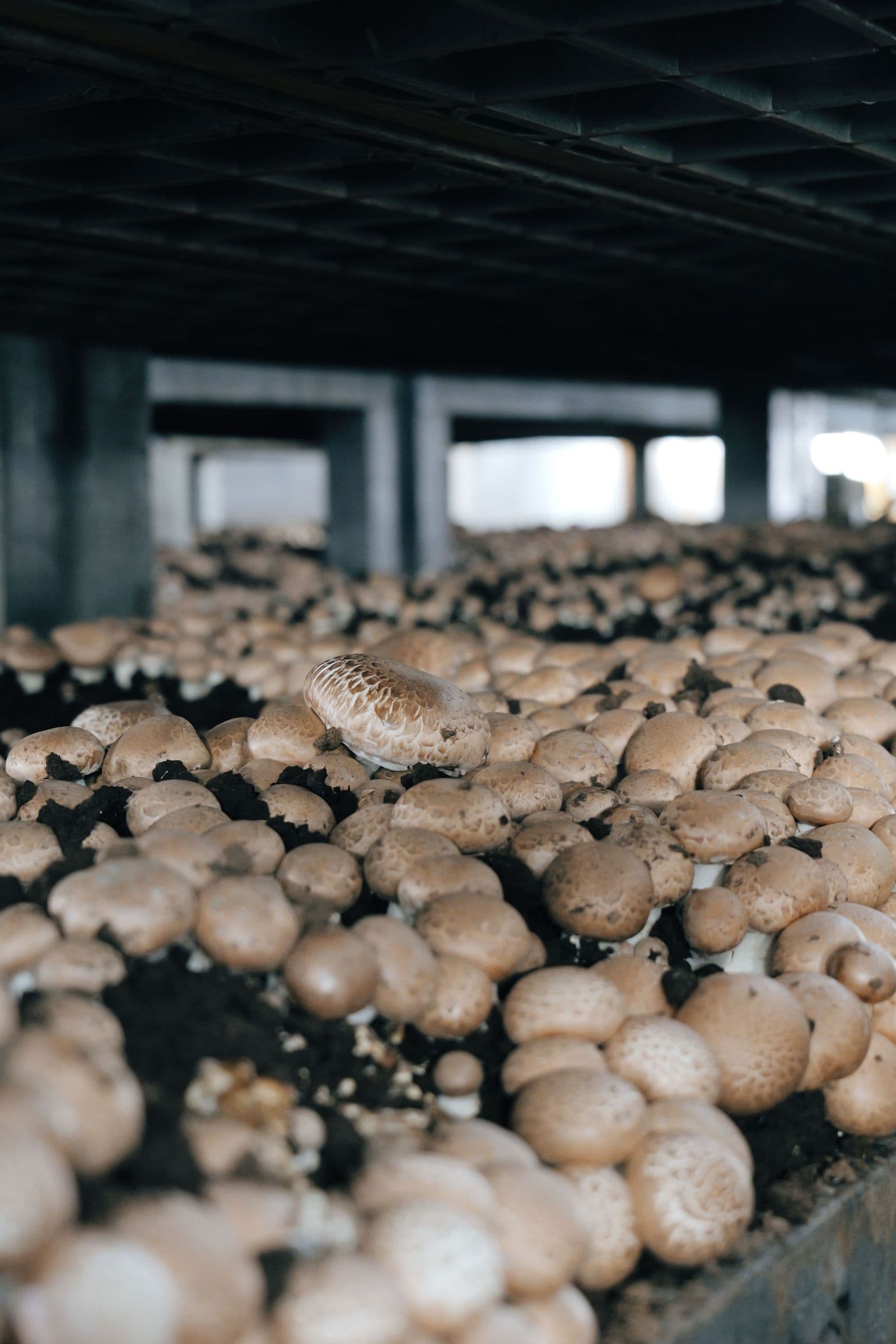
You add spawn to compost or straw and grow button or oyster mushrooms in controlled rooms; they are sold fresh or dried/processed. Buyers are vegetable mandis, hotels and restaurants, supermarkets and processing units. Fresh mushrooms must be sold within 2–3 days.
§2Is it right for you?
Who it is for
Someone who takes technical training, can monitor daily, and has access to city mandis and hotels.
Who it is not for
Someone jumping in without training, thinking it is 'easy money'.
Advantages
- High output from little land — vertical racks
- A crop in 30–45 days — money turns over quickly
- Demand is growing in hotels and cities
- Uses farm waste such as wheat straw
Drawbacks
- If temperature or humidity goes wrong, the whole crop is lost
- Fresh mushrooms have a very short shelf life
- Mandi prices swing widely between summer and winter
- Risk of contamination (green mould)
Skills you need
- Compost/spawn handling
- Temperature-humidity control
- Hygiene
- Cold chain & selling
Why difficulty 3/5: A biological process — a small mistake can lose the whole crop.
§3Market
Who buys
- Star hotels and restaurants
- Urban households
- Tourist centres
- Canning and drying units
How it sells
- Direct sale to retailers or consumers; wholesale distribution is mostly missing
- Processed (canned and dried) mushroom trade, which is more organised
Good to know
- Consumption is mostly urban; metro cities and tourist centres are the main markets (UP MSME report).
- Fresh button mushroom keeps only 3–4 days at 4–5 °C in polythene bags (NHB model report).
- Processing and good packing let you sell in far-off markets and across the year (UP MSME report).
- The NHB model is an older (2006) costing for a 200 tonnes a year farm; plant and machinery total ₹47.00 lakh.
§4Raw material & machinery
| Item | Qty | Cost |
|---|---|---|
| Production unit equipment (200 tonnes a year model) | — | ₹30.00 lakh |
| Compost and casing unit | — | ₹7.00 lakh |
| Canning facilities, spawn lab and other equipment | — | ₹10.00 lakh |
From: National Horticulture Board – Model Project Report: Button Mushroom (2006)
- Cereal straw (paddy or wheat) or sugarcane bagassemain compost base; about 220 g dry material per 1 kg of mushroom
- Fertiliser salts: urea, superphosphate, gypsumadded while making compost
- Rice bran or wheat brancompost supplement
- Spawn (mushroom seed)0.5–0.75% of compost weight
- Casing soilgarden loam and sand (4:1) or decomposed cow dung and loam (1:1), treated before use
- Perforated polythene bagsfor 250–500 g retail packs
From: National Horticulture Board – Model Project Report: Button Mushroom (2006)
Suppliers in Building Business Bazaar
Aloe Vera, Turmeric Moring And Mushroom Value Addition Cluster · Namsai →Mushroom And Baby Corn Processing And Value Addition Cluster · Gaya →Nagaland Shiitake Mushroom And Other Food Processing Cluster · Dimapur →Norbuchoeling Shiitake Mushroom & Other Food Processing Cluster · South District →Oyester Mushroom Cluster · East Jaintia Hills →Sumbuk Shitake Mushroom & Other Food Processing Cluster · South District →West Sikkim Shiitake Mushroom & Other Food Processing Cluster · West District →
In our raw material database
§5Licences & registration
- Udyam
- GST (on processing)
- FSSAI (for selling packed/processed products)
- Electricity connection (agri/commercial)
§6Schemes & subsidies
- NHBCentralActive35% back-ended subsidy
- PMFMECentralUnclear35% subsidy, up to ₹10 lakh
- MudraCentralActiveLoan up to ₹20 lakh, no collateral
- PMEGPCentralActive15–35% subsidy
- AIFCentralUnclear3% interest subvention, up to ₹2 crore
MIDH/NHB gives assistance for mushroom production units (confirm with the state horticulture department). The processing (dried/canned) part comes under PMFME. MUDRA for allied agriculture; PMEGP with processing; AIF for post-harvest/cold chain infrastructure.
§7Money
How the investment is worked out: Min = gross fixed assets ₹13.69 L. Max = start funds: share capital ₹2.00 L + term loan ₹12.77 L + cash credit ₹5.22 L, summed from report cash-flow statement (no single cost line in report).
Working capital: Compost, spawn and packing are big costs — first-year raw material ₹53.87 L in the report.
Report 2024. A climate-controlled (AC) button unit costs a lot more than this — this is the report's model.
§8Export potential
Confirm the HS code in the DGFT ITC(HS) lookup before you export
Export council / board: APEDA
- The Middle East and Western countries with Indian populations have demand for packed and canned mushrooms (UP MSME report).
- Build a brand at home first, then look at export (UP MSME report).
§9Risks — where people fail
- Crop failure from contamination
- Price crash in season
- Power cuts (AC units)
- Short shelf life
§1030 / 60 / 90-day plan
A general plan that applies to any business. A plan for this business will be added after research.
- Days 1–30: Visit a working mushroom cultivation & processing unit, ask 10 buyers about price and quantity, and get quotations from 3 suppliers.
- Days 31–60: Udyam and the licences you need (Udyam, GST (on processing)), a project report (DPR), and the scheme or loan file.
- Days 61–90: Space and machines, trial production, and first deliveries to 10 customers.
§11Who to connect with
Associations, clusters and training institutes — the directory is being built. Connect
§12Watch
There is no episode on this business yet. Shows are coming soon on the Podcast page.
Want to start Mushroom Cultivation & Processing?
DPR, loan file or registration — ask us on WhatsApp.
¶Sources
Data review: 6 October 2026. Spotted a mistake? Report it. For information only — not legal or financial advice.