

§1What this business is
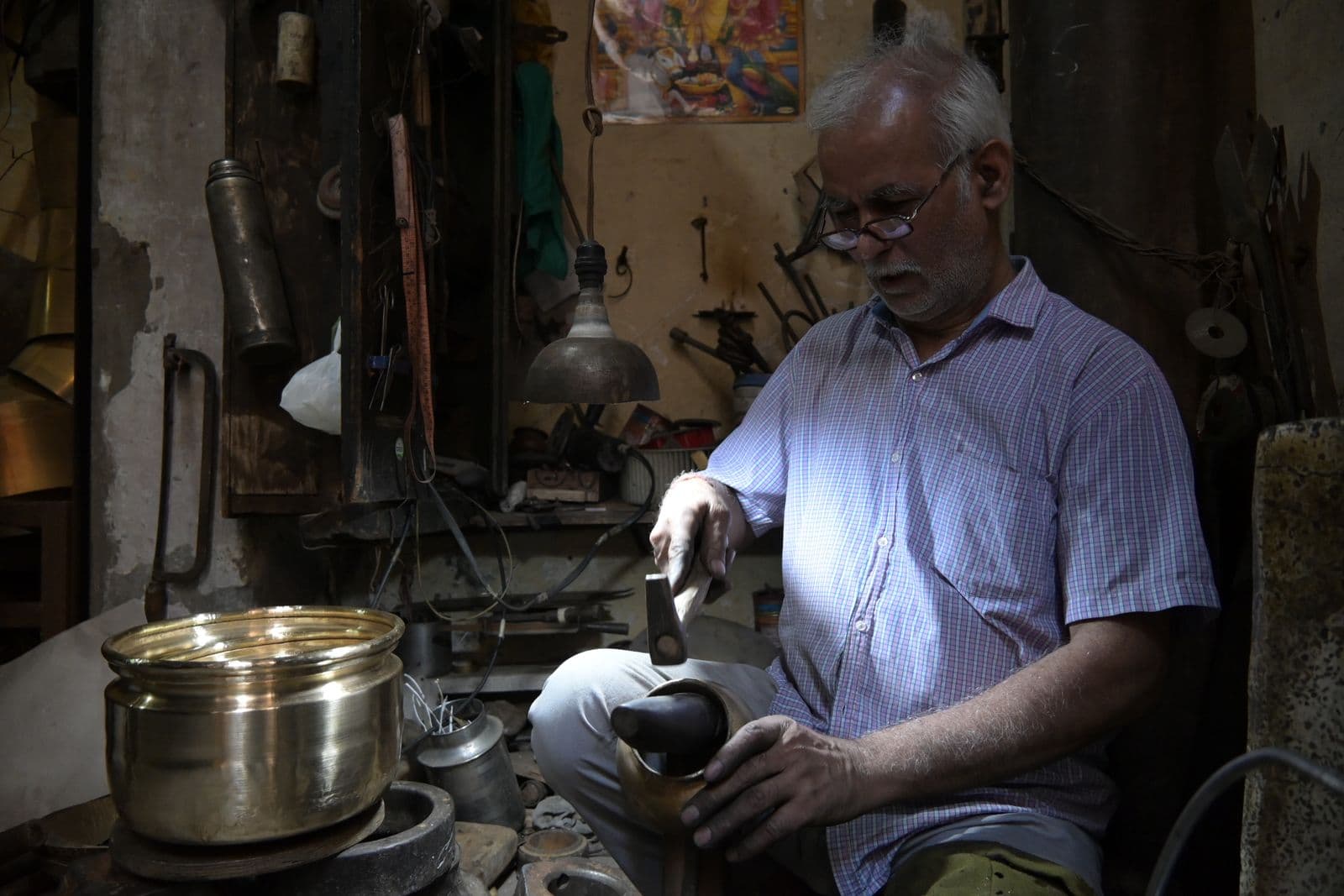
Aluminium sheet or circles are cut, deep-drawn on a power press, spun on a lathe, trimmed, polished and packed as utensils. The Samadhan report also rolls its own sheet from ingots and scrap. Buyers are households (mostly through utensil shops), hotels, canteens and institutions. Aluminium utensils sell because they are cheap, light and heat fast.
Capacity: Samadhan: 300 MT of utensils a year at full capacity (1 MT a shift, 300 days); year 1 at 50% = 150 MT. KVIC: production worth ₹37.87 L a year.
§2Is it right for you?
Who it is for
Someone with metal-pressing or utensil-trade experience who can sell to utensil dealers and hotels.
Who it is not for
Someone without the working capital to hold a month of finished stock.
Advantages
- Aluminium utensils sell in every town and village
- Hotels, canteens and institutions buy in bulk
- Process scrap goes back into the furnace
- Simple pressing and spinning skills
Drawbacks
- Aluminium price swings eat the margin
- Stainless steel and branded non-stick cookware compete hard
- Raw material is most of the cost (₹182.25 L of the ₹202.53 L cost of production in year 1 of the Samadhan report)
- Heavy presses and rolling mills need a strong shed and good power
Skills you need
- Press and spinning work
- Buying aluminium circles and scrap
- Design and product mix
- Dealer sales
Why difficulty 3/5: Machinery is simple, but metal prices and competition keep margins tight.
§3Market
Who buys
- Households of all income groups
- Hotels, restaurants and canteens
- Defence, railways and other institutions
How it sells
- Utensil wholesalers and retail shops
- Direct supply to hotels and canteens
- Exports (the Samadhan report notes export demand)
Good to know
- Utensils are replaced every 6–7 years, so there is steady replacement demand (Samadhan report).
- Product mix and design choice decide profit, says the report.
§4Raw material & machinery
| Item | Qty | Cost |
|---|---|---|
| Rolling machine, spinning lathe, power press, deep drawing machine, circle cutting, furnace, annealing plant, grinder, tools and dies | 1 set | ₹8.00 lakh |
| Aluminium hot rolling mill (350 × 900 mm rolls, 40 HP) | 1 | ₹1,50,000 |
| Aluminium cold rolling mill (350 × 900 mm, 40 HP) | 1 | ₹2,00,000 |
| Double-action deep drawing power press, 100 MT, 15 HP | 1 | ₹2,00,000 |
| Hand fly press No. 4 | 1 | ₹78,000 |
| Centre lathe, 2.5 m bed | 1 | ₹40,000 |
| Oil-fired pit furnace with burners | 1 | ₹30,000 |
| Annealing furnace 1800 × 600 mm | 1 | ₹30,000 |
| Circle cutting machine, spinning lathe, shearing machine, blower, oil preheater, weighing machine, drill, welder, grinder | 1 each | — |
| Deep drawing dies, spinning dies, slab moulds, acid tank, tools and testing equipment | 1 lot | ₹95,000 |
From: KVIC Project Profile — Aluminium Utensil Unit (PMEGP) · PMEGP sample project report — Aluminium Utensils (prepared by Udyami/Samadhan)
- Aluminium sheets and circles, 16–20 SWG, 99–99.5% puritythe Samadhan report costs sheet at ₹1,35,000 per MT with 90% recovery
- Aluminium ingots and food-grade scrapunidentified scrap with copper, zinc or lead must not be used
- Labels and packing material₹10,000 a year in the KVIC profile
From: PMEGP sample project report — Aluminium Utensils (prepared by Udyami/Samadhan) · KVIC Project Profile — Aluminium Utensil Unit (PMEGP)
In our raw material database
Aluminium ingot, billet and wire rod (primary) →Aluminium sheet, coil and plate (flat rolled) →
§5Licences & registration
- Udyam
- GST
- Factory licence if workers cross the limit
- Pollution consent from the State Pollution Control Board (furnace)
- Fire NOC
- BIS: the report names IS 1660 for wrought aluminium utensils — check whether a Quality Control Order applies
§6Schemes & subsidies
- PMEGPCentralActive15–35% subsidy
- MudraCentralActiveLoan up to ₹20 lakh, no collateral
- CGTMSECentralActiveNo collateral, up to ₹10 crore
Both reports were made for PMEGP; MUDRA up to ₹20 L and CGTMSE cover the rest.
§7Money
How the investment is worked out: KVIC profile ₹18.56 L (shed 1,500 sq ft ₹3.00 L, equipment ₹8.00 L, working capital ₹7.56 L); Samadhan report ₹25.00 L (building ₹4.50 L, plant & machinery ₹8.66 L, furniture ₹0.46 L, pre-operative ₹1.00 L, working capital ₹10.38 L).
Working capital: KVIC: ₹7.56 L. Samadhan: ₹10.38 L, of which bank finance ₹9.34 L — mostly aluminium stock (10 days) and finished goods (30 days).
Year not printed on either report — check current machinery and aluminium prices.
§8Export potential
Confirm the HS code in the DGFT ITC(HS) lookup before you export
Export council / board: EEPC India
- HS codes are from the WCO HS 2022 list; confirm the 8-digit ITC(HS) line with DGFT or your customs broker.
- You need an Import Export Code (IEC) from DGFT before the first shipment.
§9Risks — where people fail
- Aluminium price changes
- Using unidentified scrap that fails quality
- Competition from steel and branded cookware
- Press accidents
§1030 / 60 / 90-day plan
A general plan that applies to any business. A plan for this business will be added after research.
- Days 1–30: Visit a working aluminium utensils unit, ask 10 buyers about price and quantity, and get quotations from 3 suppliers.
- Days 31–60: Udyam and the licences you need (Udyam, GST), a project report (DPR), and the scheme or loan file.
- Days 61–90: Space and machines, trial production, and first deliveries to 10 customers.
§11Who to connect with
Associations, clusters and training institutes — the directory is being built. Connect
§12Watch
There is no episode on this business yet. Shows are coming soon on the Podcast page.
Want to start Aluminium Utensils?
DPR, loan file or registration — ask us on WhatsApp.
¶Sources
- KVIC Project Profile — Aluminium Utensil Unit (PMEGP)
- PMEGP sample project report — Aluminium Utensils (prepared by Udyami/Samadhan)
Data review: 6 October 2026. Spotted a mistake? Report it. For information only — not legal or financial advice.