

§1What this business is
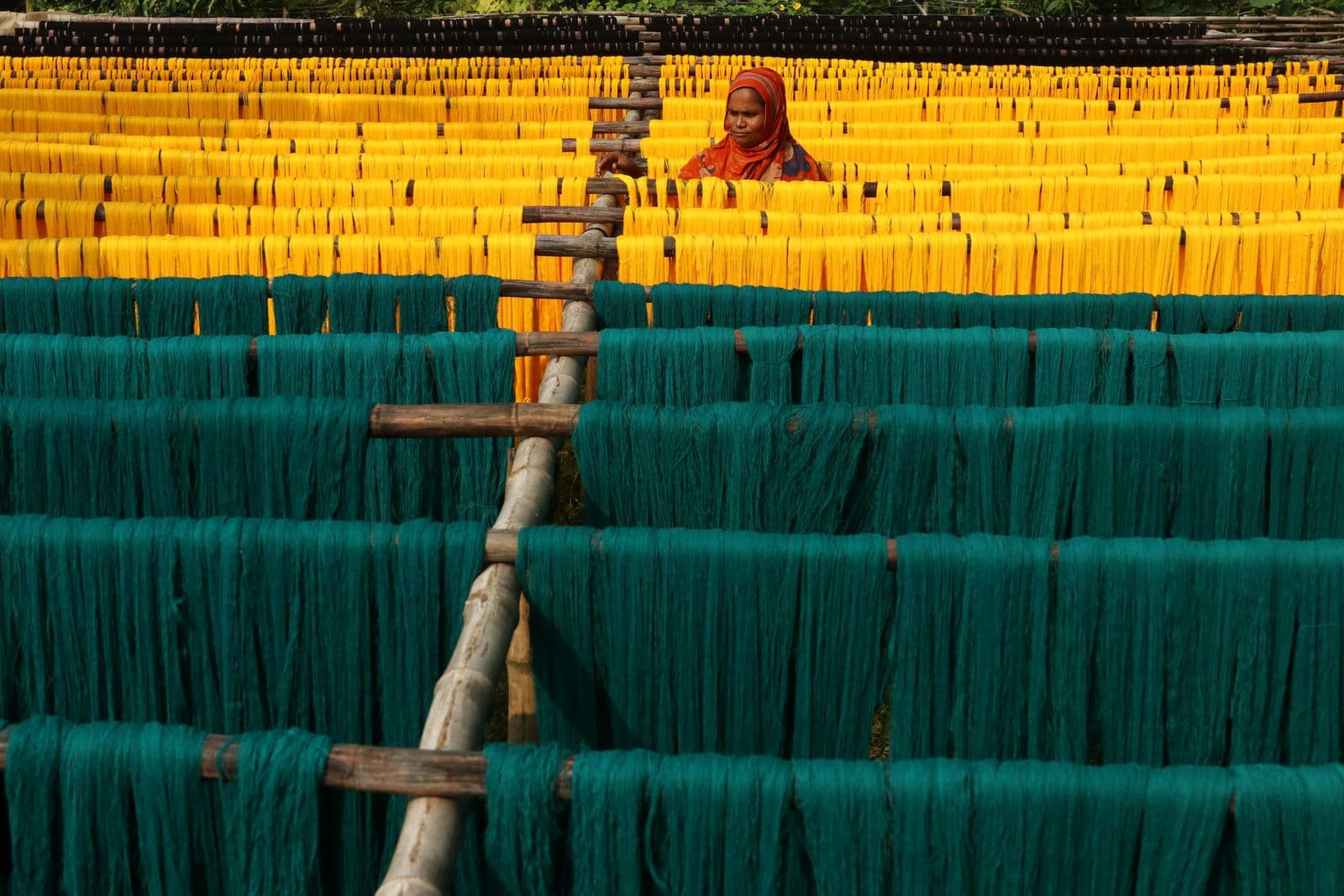
Grey knitted fabric is boiled for 6–8 hours in a kier with caustic soda, soda ash and wetting agent, washed, bleached in stainless steel winches with bleaching powder, soured with dilute acid and washed again. For white goods an optical whitener is added; for colour, the fabric runs in winches with salt and dyes until the shade is even. It is then hydro-extracted, dried on a cylinder drier and calendered. Winches are used because they put little tension on knitted fabric. Most knitting units send their fabric out for this, paying a processing charge.
Capacity: 3,00,000 kg a year: 1,50,000 kg bleached at ₹18 a kg and 1,50,000 kg dyed at ₹23 a kg — ₹61.50 L in processing charges.
§2Is it right for you?
Who it is for
A dyeing master or textile chemist in a hosiery cluster such as Ludhiana or Tiruppur.
Who it is not for
Someone outside a knitting cluster or unable to meet effluent rules.
Advantages
- Job work — no money tied up in fabric
- Knitting units in hosiery clusters need outside processing
- Can start with a few winches and add more
- The ₹18 L colour-matching system is optional
Drawbacks
- Coloured effluent must be treated before discharge
- Needs a lot of soft water and steam
- Shade mistakes mean paying for the customer's fabric
- Price pressure from big processing houses
Skills you need
- Dye chemistry and shade matching
- Running kiers, winches and boilers
- Effluent treatment
- Keeping job-work customers on schedule
Why difficulty 3/5: Chemistry, boilers and strict effluent rules, but no fabric stock to finance.
§3Market
Who buys
- Knitting units without their own processing
- Hosiery garment makers
- Fabric traders
How it sells
- Job work collected from knitting units
- Regular contracts with garment exporters
Good to know
- The profile says most knitted-cloth units have no captive processing and pay outside units to bleach and dye.
- It ties demand to the growth of hosiery garments in the domestic and export markets.
§4Raw material & machinery
| Item | Qty | Cost |
|---|---|---|
| Stainless steel winch machine, 200 kg | 1 | ₹1,05,000 |
| Stainless steel winch machines, 150 kg | 3 | ₹3,00,000 |
| MS kiers | 2 | ₹1,40,000 |
| Four-cylinder drier with motor and gear box | 1 | ₹2,30,000 |
| Hydro-extractors, 40–45 kg | 2 | ₹1,40,000 |
| Steam calendering machine | 1 | ₹70,000 |
| Baby boiler | 1 | ₹1,20,000 |
| Water softening plant, 6 kl an hour | 1 | ₹75,000 |
| Effluent treatment plant | 1 | ₹50,000 |
| Deep tube well with submersible pump | 1 | ₹1,25,000 |
| Computer colour matching equipment (optional) | 1 | ₹18,00,000 |
From: DC-MSME project profile — Bleaching and Dyeing of Cotton Knitted Fabric (2003)
- Dyes of different shades₹80,000 a month in the profile
- Soda ash1,750 kg a month at ₹14 a kg in the profile
- Hydrochloric acid2,400 kg a month at ₹6 a kg in the profile
- Bleaching powder1,000 kg a month at ₹13 a kg in the profile
- Caustic soda, wetting agent, optical whitener, dye-fixing agent, salts and acids
- Coal or furnace oil for the boiler₹20,000 a month in the profile
From: DC-MSME project profile — Bleaching and Dyeing of Cotton Knitted Fabric (2003)
Suppliers in Building Business Bazaar
Crescent Dye Industries · Ludhiana →Data Colour · Mumbai →Dynamic Engg. Corpn · Delhi →Gangan Mech. Works · Ludhiana →ICI (India) Ltd · Delhi →Paradise Engg. Corpn · Ludhiana →Rangila Dyes Co · Ludhiana →Sarjeevan Dyes Mfr. Co · Ludhiana →
In our raw material database
Caustic soda (sodium hydroxide) →Hydrogen peroxide →Reactive dyes →
§5Licences & registration
- Udyam registration
- GST
- State Pollution Control Board consent to establish and operate (dyeing effluent)
- Groundwater permission if you draw from a tube well, where the state requires it
- Boiler registration under the Boilers Act if your boiler is covered
- Factory licence under the Factories Act
§6Schemes & subsidies
- PMEGPCentralActive15–35% subsidy
- MudraCentralActiveLoan up to ₹20 lakh, no collateral
- CGTMSECentralActiveNo collateral, up to ₹10 crore
- Stand-Up IndiaCentralClosed₹10 lakh – ₹1 crore loan
PMEGP fits the project size; MUDRA covers loans up to ₹20 L; CGTMSE for loans without collateral; Stand-Up India for SC/ST or women founders.
§7Money
How the investment is worked out: DC-MSME profile (SISI Ludhiana, May 2003): fixed capital ₹35.37 L (machinery ₹33.73 L — of which an optional computer colour-matching system is ₹18 L — plus erection, furniture and pre-operative ₹1.64 L) + working capital for 3 months ₹10.68 L = ₹46.04 L. Shed rented at ₹12,000 a month.
Working capital: Working capital is ₹10.68 L for 3 months; chemicals and dyes cost about ₹2.13 L a month. You do not buy the fabric — customers send it.
Prices from 2003 — machinery, raw material and wage costs will be much higher now.
§8Export potential
Export council / board: Not applicable
- A job-work processing service; the fabric owner exports, not the dyer.
§9Risks — where people fail
- Stricter effluent rules (some clusters need zero liquid discharge)
- Claims for shade variation or damaged fabric
- Dye and chemical price rises
- Fuel cost for the boiler
§1030 / 60 / 90-day plan
A general plan that applies to any business. A plan for this business will be added after research.
- Days 1–30: Visit a working bleaching and dyeing of cotton knitted fabric (job work) unit, ask 10 buyers about price and quantity, and get quotations from 3 suppliers.
- Days 31–60: Udyam and the licences you need (Udyam registration, GST), a project report (DPR), and the scheme or loan file.
- Days 61–90: Space and machines, trial production, and first deliveries to 10 customers.
§11Who to connect with
Associations, clusters and training institutes — the directory is being built. Connect
§12Watch
There is no episode on this business yet. Shows are coming soon on the Podcast page.
Want to start Bleaching and Dyeing of Cotton Knitted Fabric (Job Work)?
DPR, loan file or registration — ask us on WhatsApp.
¶Sources
Data review: 6 October 2026. Spotted a mistake? Report it. For information only — not legal or financial advice.