

§1What this business is
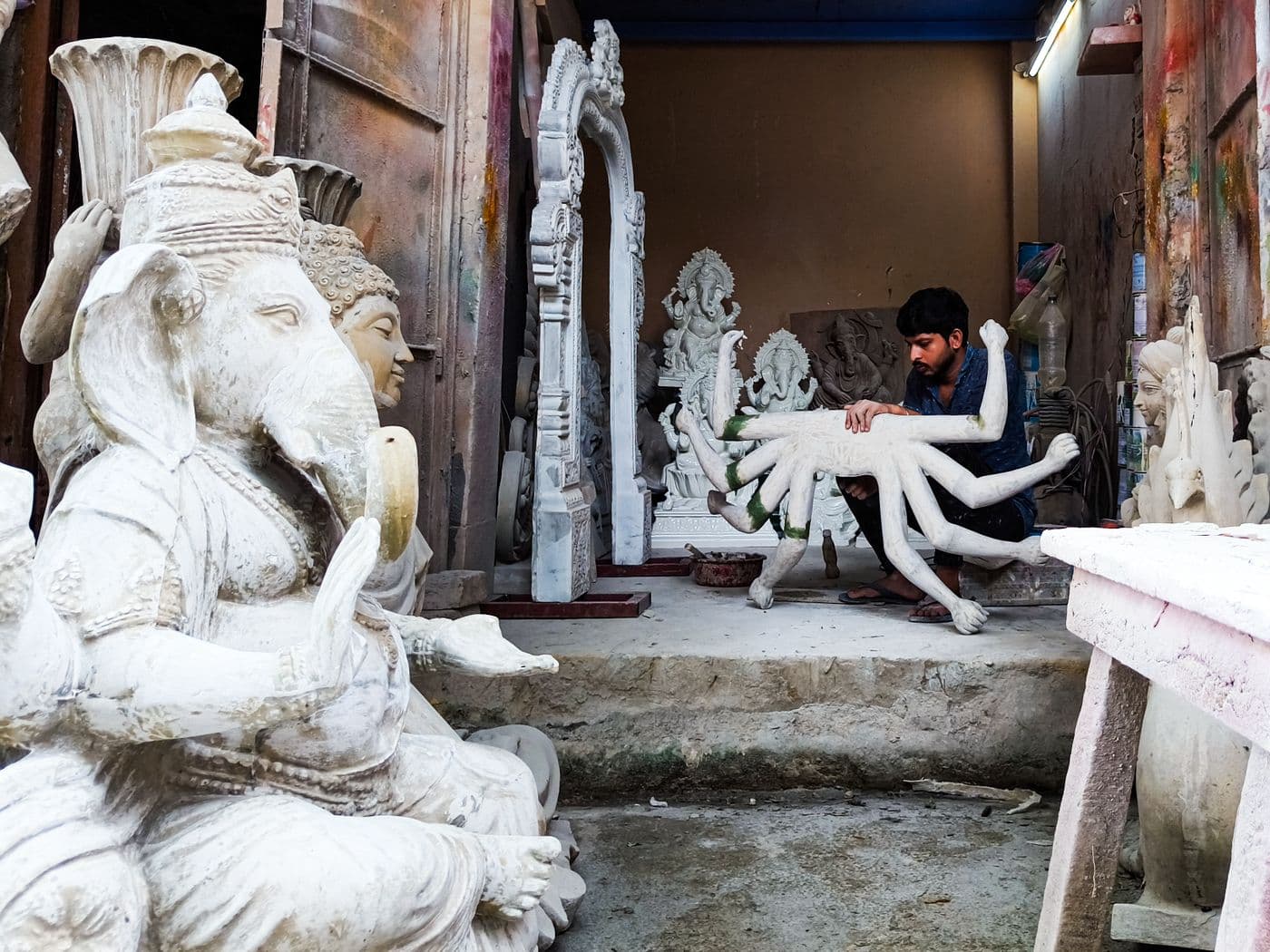
A floral or geometric design is cut on a brass sheet, traced on marble and carved out with hand chisels; slices of coloured and semi-precious stones are shaped on a hand-driven wheel (saan and kamaani), set into the grooves with traditional glue, then polished to a deep shine. Products such as table tops, plates, coasters, chess boards, vases, photo frames and statues go to art galleries, tourist shops, temples, corporate buyers and export. It is a Mughal-era craft kept alive by a few artisan families.
Capacity: 100 pieces a day; year 1 at 50%.
§2Is it right for you?
Who it is for
An artisan family or craft entrepreneur in a marble-inlay cluster with access to tourist and export buyers.
Who it is not for
Someone without access to trained inlay artisans.
Advantages
- Unique heritage craft with a strong story
- High value in tourist and export markets
- Very low power and machine needs
- Corporate gifting and temple orders
Drawbacks
- Depends on a small pool of master artisans
- Slow, skilled handwork limits output
- Tourist demand swings
- Cheap imitations hurt prices
Skills you need
- Design and marble carving
- Stone shaping and setting
- Polishing
- Gallery, tourist and export selling
Why difficulty 3/5: Needs rare skilled artisans and good buyers; the business side is simple.
§3Market
Who buys
- Art galleries and handicraft emporiums
- Tourist-market shops
- Temples (statues)
- Corporate gift buyers
- Overseas importers
How it sells
- Showroom or workshop sales to tourists
- Handicraft fairs and exhibitions
- Export through merchant exporters
- Online craft platforms
Good to know
- The report lists products such as plates, boxes, trays, coaster sets, chess and backgammon boards, vases, pen holders, photo frames, statues and calligraphy.
- It notes a marble inlay table top may cost from about 80 US dollars, depending on size and intricacy.
§4Raw material & machinery
| Item | Qty | Cost |
|---|---|---|
| Traditional geometric tools (dividing and sketching the design) | 1 set | — |
| Saan and kamaani (hand-driven lapidary wheel) | as needed | — |
| Hand-operated emery wheel | as needed | — |
| Chiselling tools (tankiya and narzi) | 1 set | — |
| All tools and equipment together | 1 lot | ₹0.60 lakh (approx.) |
From: PMEGP sample project report — Marble Inlay Sculpture (prepared by Udyami/Samadhan)
- Marble (base stone and coloured slices)average raw material ₹220–240 per piece in the report
- Semi-precious stones (malachite, cornelian, jasper, lapis lazuli, mother of pearl, coral, turquoise, tiger eye)named in the report
- Traditional glue / white putty (oil, lead oxide, wax) and polishing compoundsfor setting and polishing
From: PMEGP sample project report — Marble Inlay Sculpture (prepared by Udyami/Samadhan)
In our raw material database
§5Licences & registration
- Udyam registration
- GST
- Artisan card / handicraft registration with the Development Commissioner (Handicrafts) (optional)
- IEC for exports
§6Schemes & subsidies
- PMEGPCentralActive15–35% subsidy
- MudraCentralActiveLoan up to ₹20 lakh, no collateral
- CGTMSECentralActiveNo collateral, up to ₹10 crore
- Stand-Up IndiaCentralClosed₹10 lakh – ₹1 crore loan
PMEGP fits; MUDRA covers loans up to ₹20 L; CGTMSE; Stand-Up India for SC/ST or women founders.
§7Money
How the investment is worked out: Samadhan report: cost of project printed as ₹11.66 L = civil work ₹5.40 L + furniture and fixtures ₹2.00 L + working capital ₹4.26 L. Tools and equipment are listed at about ₹0.60 L. (The PMEGP portal lists this report at ₹18.31 L; the figure printed inside the report is used here.)
Working capital: Marble and stones average ₹220–240 per piece; working capital ₹4.26 L (bank ₹3.84 L).
Year not printed on the report — check current machinery prices.
§8Export potential
Confirm the HS code in the DGFT ITC(HS) lookup before you export
Export council / board: Export Promotion Council for Handicrafts (EPCH)
- Confirm the 8-digit ITC(HS) line with DGFT or your customs broker.
- You need an Import Export Code (IEC) from DGFT before the first shipment.
§9Risks — where people fail
- Artisan shortage
- Tourism slowdowns
- Breakage in transport
- Imitation products
§1030 / 60 / 90-day plan
A general plan that applies to any business. A plan for this business will be added after research.
- Days 1–30: Visit a working marble inlay (pietra dura) craft unit, ask 10 buyers about price and quantity, and get quotations from 3 suppliers.
- Days 31–60: Udyam and the licences you need (Udyam registration, GST), a project report (DPR), and the scheme or loan file.
- Days 61–90: Space and machines, trial production, and first deliveries to 10 customers.
§11Who to connect with
Associations, clusters and training institutes — the directory is being built. Connect
§12Watch
There is no episode on this business yet. Shows are coming soon on the Podcast page.
Want to start Marble Inlay (Pietra Dura) Craft?
DPR, loan file or registration — ask us on WhatsApp.
¶Sources
Data review: 6 October 2026. Spotted a mistake? Report it. For information only — not legal or financial advice.