

§1What this business is
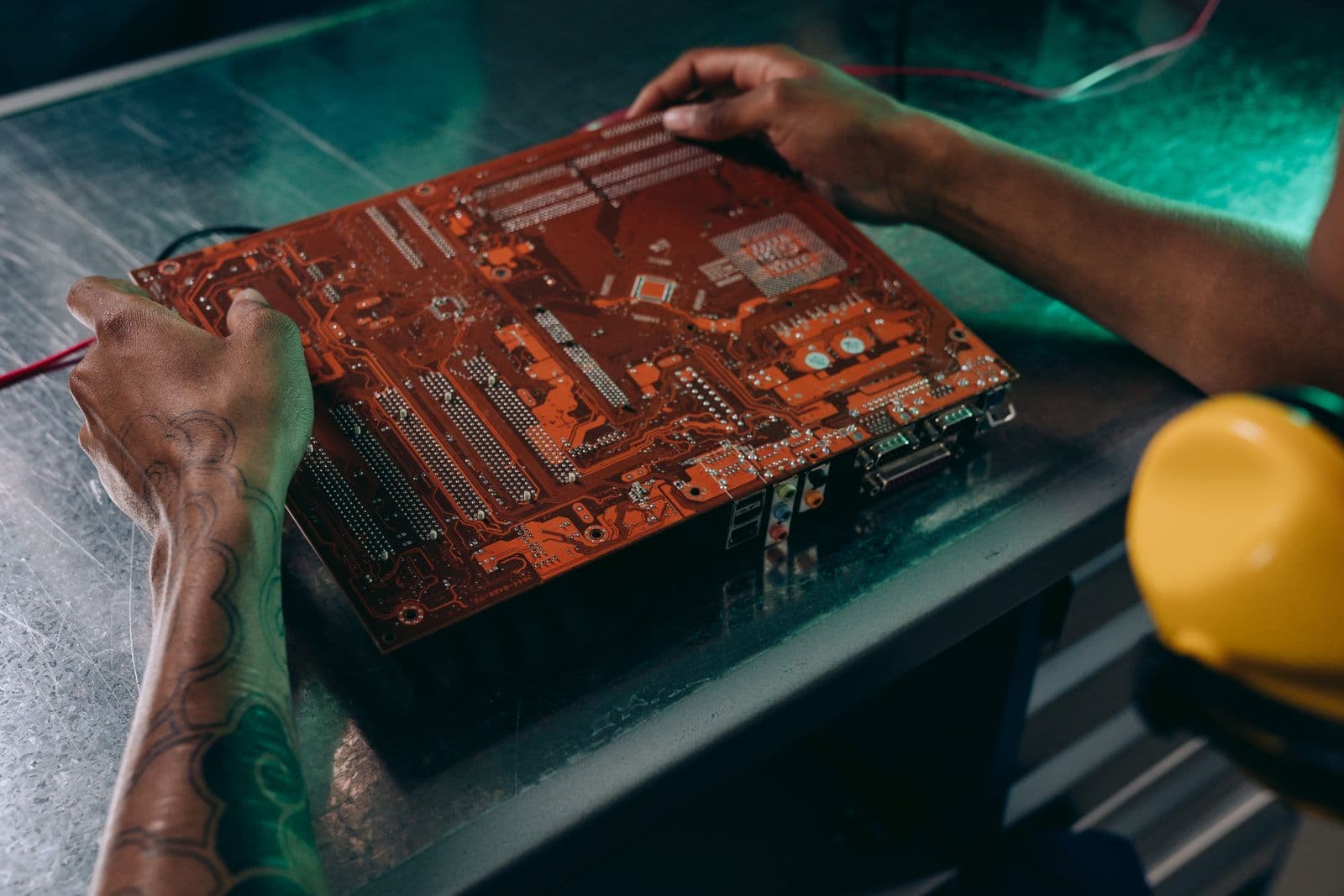
Incoming boards and components are tested, then components are placed on the PCB at their marked positions along a small assembly line. The loaded boards pass over a heat-wave soldering bath, extra leads are trimmed, joints are checked under a magnifier lamp, and each board is tested on jigs before dispatch. It is a four-person, rented-space unit doing through-hole assembly for makers of electronic products. India imports about 65% of its PCB demand, according to the profile.
Capacity: Not printed in boards; sales of ₹21.60 L a year at full capacity, starting at 60% (₹12.96 L).
§2Is it right for you?
Who it is for
A graduate with electronics or electrical maintenance experience, as the profile suggests, with contacts among electronics makers.
Who it is not for
Someone without electronics skills or an anchor customer for job work.
Advantages
- Small start — ₹9.72 L in rented space
- Low break-even at 21.93% in the profile
- India's electronics manufacturing is growing fast
- High gross margin because much of the work is labour and skill
Drawbacks
- Through-hole hand assembly is losing ground to automated surface-mount lines
- Depends on a few electronics makers for orders
- Soldering faults lead to rejections and rework
- Component shortages can stop orders
Skills you need
- Component identification and placement
- Wave and hand soldering
- Board testing with oscilloscope, multimeter and jigs
- Getting job-work orders from manufacturers
Why difficulty 2/5: Small and quick to set up, but needs skilled soldering and steady job orders.
§3Market
Who buys
- Consumer electronics makers
- Telecom, automotive and healthcare equipment makers
- Electrical product makers (lighting, controls)
How it sells
- Job-work contracts with manufacturers
- Electronics manufacturing clusters
Good to know
- The profile puts the Indian PCB market at USD 920 million and says about 65% of demand is met by imports.
- The profile cites an ELCINA study projecting PCB demand growth of 20.56% a year for 2015–2020.
§4Raw material & machinery
| Item | Qty | Cost |
|---|---|---|
| Heat-wave soldering machine | 1 | ₹60,000 |
| Oscilloscope (50 MHz), LCR-Q meter, function generator and 0–30 V, 3 A power supplies | 1 set | ₹65,000 |
| Digital and analogue multimeters | 1 set | ₹25,000 |
| Magnifying glass with tube light | 1 | ₹0.30 lakh |
| Temperature-controlled soldering station, 25 W and 65 W soldering irons, rheostat | 1 set | ₹1,00,000 |
| Installation, electrification, taxes and transport | lump sum | ₹1,20,000 |
From: SIDBI Stand-Up Mitra project profile — PCB & Mountings (2018) — private guide — confirm locally
- Printed circuit boardsusually supplied or specified by the customer
- Electronic components: resistors, capacitors, coils, diodes, transistors, ICs, SCRstested on arrival for specification
- Solder and fluxfor the wave-soldering bath and hand touch-up
From: SIDBI Stand-Up Mitra project profile — PCB & Mountings (2018) — private guide — confirm locally
Suppliers in Building Business Bazaar
Institute for Design of Electrical Measuring Instruments (IDEMI), Mumbai · Mumbai →Electronics Service & Training Centre (ESTC), Ramnagar · Ramnagar →MSME Technology Centre, Puducherry · Puducherry →MSME Technology Centre, Greater Noida · Greater Noida →MSME Technology Centre, Bengaluru · Bengaluru →
§5Licences & registration
- Udyam registration
- GST registration
- Trade licence from the local body
- State Pollution Control Board consent where required (soldering fumes, lead)
- Extended Producer Responsibility under the E-Waste (Management) Rules if you sell finished electronic products under your own brand
§6Schemes & subsidies
- PMEGPCentralActive15–35% subsidy
- MudraCentralActiveLoan up to ₹20 lakh, no collateral
- CGTMSECentralActiveNo collateral, up to ₹10 crore
PMEGP fits a ₹9.72 L manufacturing project; MUDRA (Kishore/Tarun) covers the whole cost; CGTMSE for a loan without collateral.
§7Money
How the investment is worked out: Plant and machinery ₹4.00 L (wave soldering, test instruments, soldering stations, installation) + furniture, computer and electricals ₹1.00 L + preliminary expenses ₹0.40 L + working capital ₹4.32 L = ₹9.72 L. No land or building (rented).
Working capital: Working capital ₹4.32 L (stocks ₹2.16 L, receivables ₹1.08 L, overheads ₹1.08 L); margin ₹1.89 L, bank ₹2.43 L. Finance: owner ₹2.43 L, bank ₹7.29 L.
SIDBI Stand-Up Mitra profile, uploaded in 2018 (no year printed on it) — prices will be higher now; check current costs.
§8Export potential
Confirm the HS code in the DGFT ITC(HS) lookup before you export
Export council / board: ESC (Electronics and Computer Software Export Promotion Council)
- Assembled boards are classified with the product they are part of; check the heading with your customs broker.
- You need an Import Export Code (IEC) from DGFT before the first shipment.
§9Risks — where people fail
- Losing a main customer
- Shift of buyers to automated SMT assembly
- Static or heat damage to components
- Late payments from small electronics firms
§1030 / 60 / 90-day plan
A general plan that applies to any business. A plan for this business will be added after research.
- Days 1–30: Visit a working pcb assembly (component mounting) unit unit, ask 10 buyers about price and quantity, and get quotations from 3 suppliers.
- Days 31–60: Udyam and the licences you need (Udyam registration, GST registration), a project report (DPR), and the scheme or loan file.
- Days 61–90: Space and machines, trial production, and first deliveries to 10 customers.
§11Who to connect with
Associations, clusters and training institutes — the directory is being built. Connect
§12Watch
There is no episode on this business yet. Shows are coming soon on the Podcast page.
Want to start PCB Assembly (Component Mounting) Unit?
DPR, loan file or registration — ask us on WhatsApp.
¶Sources
Data review: 6 October 2026. Spotted a mistake? Report it. For information only — not legal or financial advice.