

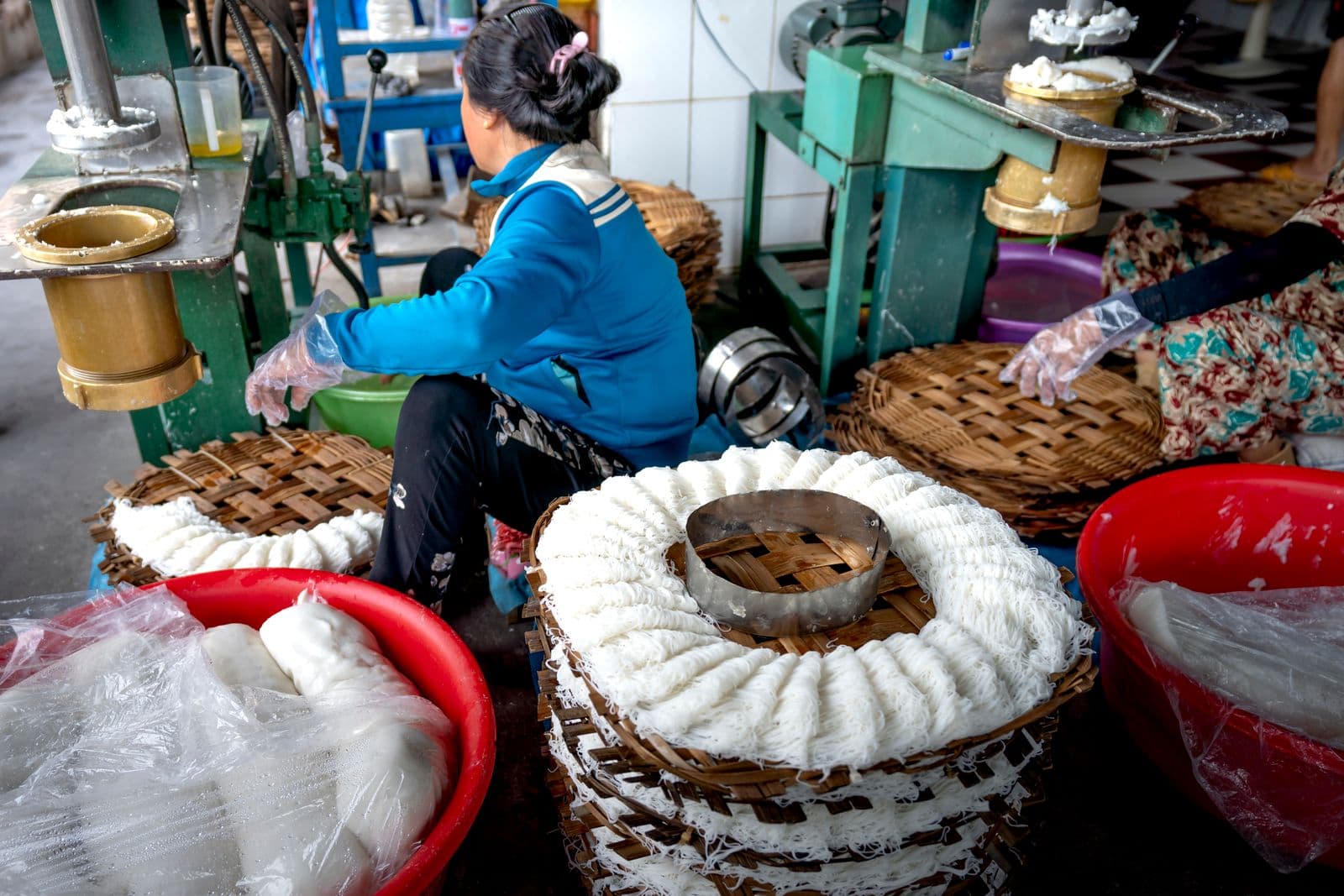
§1What this business is
Sticky rice is cleaned, dry-milled into flour (below 10% moisture), mixed with water into dough, steamed, rolled into sheets, cut into strands, fried at 140–160 °C for 60–100 seconds, quickly frozen and packed. Rice noodles are gluten-free and, per the DPR, lower in calories than wheat noodles; growing interest in Asian food helps sales.
Capacity: 100 kg an hour, one 8-hour shift, 300 days = 2,16,000 kg a year after 10% wastage; the DPR starts at 30% (64,800 kg) and reaches 50% in year 5.
§2Is it right for you?
Who it is for
A food processor near sticky-rice areas (such as the North-East) or with links to Asian-food restaurants and stores.
Who it is not for
Someone without a buyer base for a niche, higher-priced noodle.
Advantages
- Gluten-free — an option for people who avoid wheat
- Rising interest in Asian food
- Low break-even (27%) in the DPR
- Sticky rice is grown in India
Drawbacks
- Sticky rice does not store well — ageing changes its texture, per the DPR
- High power load (28 KW)
- Wheat noodles from big brands are cheaper
- Frying line needs skill and adds oil cost
Skills you need
- Rice flour milling and dough control
- Steaming, sheeting and frying settings
- Food safety and packaging
- Selling to restaurants and modern retail
Why difficulty 3/5: Several process steps to control, and the market is still niche.
§3Market
Who buys
- Restaurants serving Asian food
- Grocery and modern retail stores
- Gluten-free and health-food buyers
- Households in sticky-rice regions
How it sells
- Distributors to modern retail
- Direct supply to restaurants
- Online sales
Good to know
- The DPR prices a 1 kg packet at ₹180 in year 1.
- Moisture in fried noodles is 15–22% and oil 3–6%, per the DPR.
§4Raw material & machinery
| Item | Qty | Cost |
|---|---|---|
| Vibrating grain separator | 1 | ₹1,45,000 |
| Rice flour mill | 1 | ₹2,45,000 |
| Planetary mixer | 2 | ₹1,10,000 |
| Noodle sheeter and cutter | 1 | ₹90,000 |
| Noodle frying machine | 1 | ₹4,70,000 |
| Freezing machine | 1 | ₹2,20,000 |
| Packaging machine | 1 | ₹1,50,000 |
| Bins, trolley, conveyor, silos, weighing machine | — | ₹3,00,000 |
From: NIFTEM-K project profile — Sticky Rice Noodles Unit (PMFME model DPR) (2022)
- Sticky (glutinous) ricemain raw material; quality checked on arrival, stored to avoid sprouting
- Starch water and oiloil for frying; minor improvers and antioxidants
- Packing material1 kg packets
From: NIFTEM-K project profile — Sticky Rice Noodles Unit (PMFME model DPR) (2022)
In our raw material database
§5Licences & registration
- FSSAI licence
- Udyam
- GST
- Legal Metrology registration for packed goods
- Fire NOC and State Pollution Control Board consent as required
§6Schemes & subsidies
- PMFMECentralUnclear35% subsidy, up to ₹10 lakh
- PMEGPCentralActive15–35% subsidy
- CGTMSECentralActiveNo collateral, up to ₹10 crore
- MudraCentralActiveLoan up to ₹20 lakh, no collateral
PMFME (the DPR is a PMFME model with a 35% subsidy up to ₹10 L), PMEGP and CGTMSE fit. Bank finance in the DPR is ₹16.70 L (term loan ₹11.17 L + working capital ₹5.53 L), within the MUDRA ₹20 L limit.
§7Money
How the investment is worked out: NIFTEM-K PMFME model DPR: total ₹26.44 L = plant & machinery ₹17.30 L + miscellaneous assets ₹3.00 L + working capital ₹6.14 L. Premises rented (rent ₹3.60 L in year 1).
Working capital: Working capital ₹6.14 L (bank limit ₹5.53 L). Raw material is costed at ₹90 per kg of output in year 1; a 1 kg packet sells at ₹180.
Year not printed in the DPR; NIFTEM-K published it in July 2022 — check current machinery prices.
§8Export potential
Confirm the HS code in the DGFT ITC(HS) lookup before you export
Export council / board: APEDA
- Check the ITC(HS) export policy for the exact 8-digit line before shipping.
§9Risks — where people fail
- Uneven quality from changing rice batches
- Competition from imported and branded noodles
- Oil and power cost rises
- Slow consumer uptake
§1030 / 60 / 90-day plan
A general plan that applies to any business. A plan for this business will be added after research.
- Days 1–30: Visit a working rice noodles unit (sticky rice) unit, ask 10 buyers about price and quantity, and get quotations from 3 suppliers.
- Days 31–60: Udyam and the licences you need (FSSAI licence, Udyam), a project report (DPR), and the scheme or loan file.
- Days 61–90: Space and machines, trial production, and first deliveries to 10 customers.
§11Who to connect with
Associations, clusters and training institutes — the directory is being built. Connect
§12Watch
There is no episode on this business yet. Shows are coming soon on the Podcast page.
Want to start Rice Noodles Unit (Sticky Rice)?
DPR, loan file or registration — ask us on WhatsApp.
¶Sources
Data review: 6 October 2026. Spotted a mistake? Report it. For information only — not legal or financial advice.