

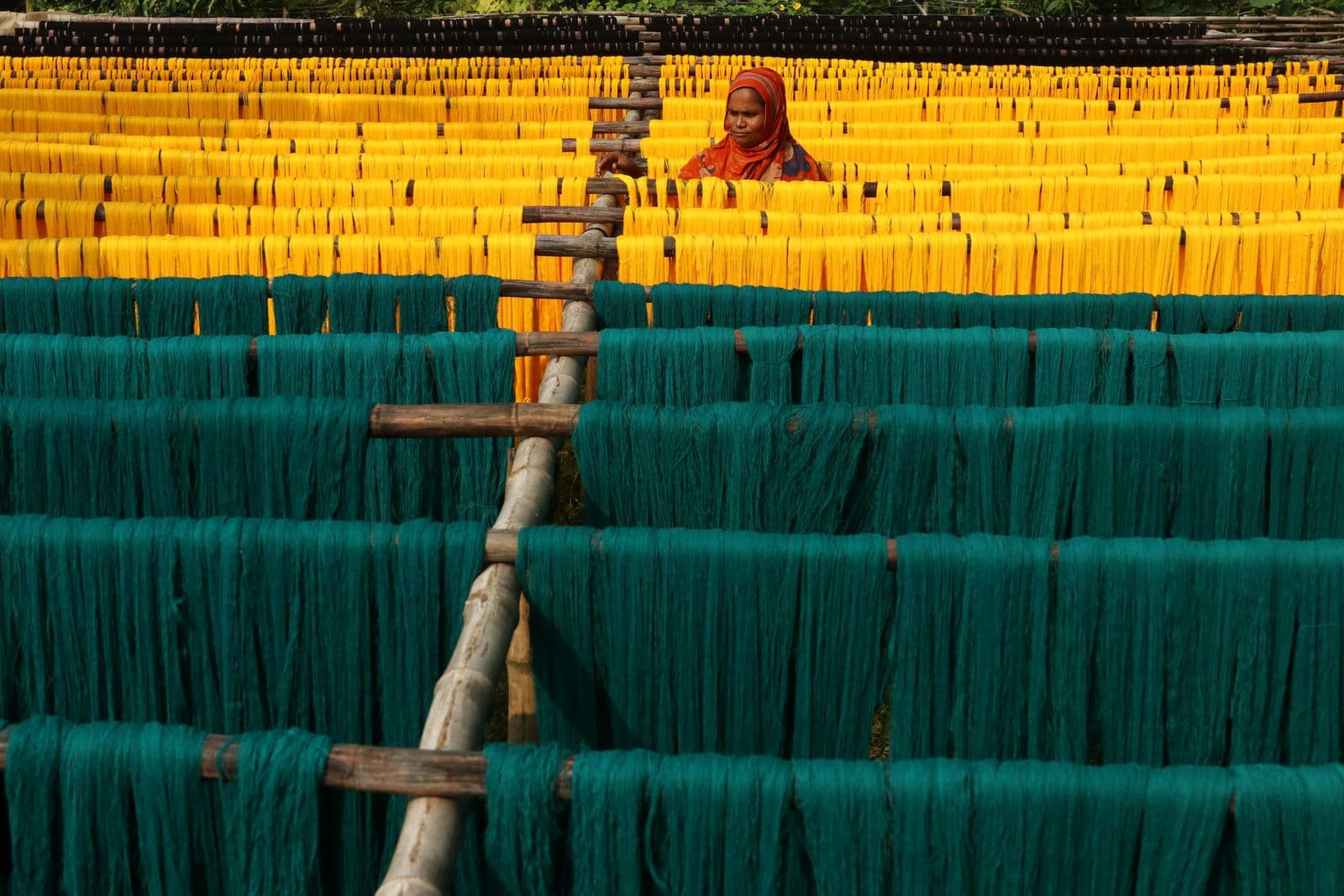
§1What this business is
Cloth is laid on long printing tables and colour is pushed through design screens with rubber squeegees. The print is fixed in a steamer, washed in a jigger, dried on a cylinder dryer and folded. Printing raises the value of plain fabric for dress material, sheets and furnishings.
Capacity: 45,000 metres of printed fabric a year.
§2Is it right for you?
Who it is for
Someone in a textile town with contacts among cloth traders and tailors, and access to skilled printers.
Who it is not for
Someone who cannot manage dye effluent or keep colour quality even.
Advantages
- Printing adds clear value to plain fabric
- Hand screen printing needs modest machinery
- Can take job work from traders and garment makers
- Designs can follow local and seasonal demand
Drawbacks
- Washing section produces coloured effluent
- Fashion changes make designs go out of date
- Job-work rates are squeezed by competition
- Wages are the biggest cost (₹5.76 lakh a year)
Skills you need
- Screen making and colour matching
- Dye and gum chemistry
- Quality checks for wash and rub fastness
- Getting job work from traders
Why difficulty 3/5: Moderate capital, but colour quality and effluent control need care.
§3Market
Who buys
- Cloth traders and wholesalers
- Garment and dress-material makers
- Retail shops selling printed fabric
How it sells
- Job work for traders
- Sale of own printed fabric to shops
- Local haats and exhibitions
Good to know
- The profile values output at ₹29 a metre for 45,000 metres.
- The profile is a model for guidance; costs change with area, raw material and power.
§4Raw material & machinery
| Item | Qty | Cost |
|---|---|---|
| Printing table with AC top (20'x15'x3'), squeegees, screens, cottage steamer, open-width jigger, cylinder drying machine, baby boiler, trolleys, dye-paste stirrer, weighing machine, installation and office furniture | — | ₹8,32,500 (total) |
From: KVIC Project Profile — Textile Printing (PMEGP)
- Dyes, gums and chemicalsraw material ₹1,50,000 a year at full capacity
- Labels and packing material₹65,000 a year
From: KVIC Project Profile — Textile Printing (PMEGP)
Suppliers in Building Business Bazaar
Bombay Textiles Research Association (BTRA), Mumbai · Mumbai →Northern India Textile Research Association (NITRA), Ghaziabad · Ghaziabad →
In our raw material database
§5Licences & registration
- Udyam registration
- GST registration
- Pollution Control Board NOC (washing effluent)
- Trade licence from the local body
§6Schemes & subsidies
- PMEGPCentralActive15–35% subsidy
- MudraCentralActiveLoan up to ₹20 lakh, no collateral
- CGTMSECentralActiveNo collateral, up to ₹10 crore
PMEGP fits this ₹9.45 lakh unit; MUDRA can cover it; CGTMSE gives collateral-free cover.
§7Money
How the investment is worked out: KVIC profile total ₹9,44,500: equipment ₹8,32,500 (printing table with AC top 20'x15'x3', squeegees, screens, cottage steamer, open-width jigger, cylinder drying machine, baby boiler, trolleys, dye-paste stirrer, weighing machine, installation, electrification, office furniture) and working capital ₹1,12,000. Work shed rented.
Working capital: Working capital ₹1,12,000 per cycle (fixed cost ₹4,11,550, variable cost ₹9,25,560 a year).
Year not printed on the KVIC profile — check current machinery prices.
§8Export potential
Confirm the HS code in the DGFT ITC(HS) lookup before you export
Export council / board: Cotton Textiles Export Promotion Council (TEXPROCIL)
- Register with TEXPROCIL and get an IEC before exporting cotton fabric.
- Buyers abroad often ask for colour-fastness and azo-free dye test reports.
§9Risks — where people fail
- Effluent rules and pollution complaints
- Colour bleeding and rejects
- Late payment on job work
- Competition from big mechanised printers
§1030 / 60 / 90-day plan
A general plan that applies to any business. A plan for this business will be added after research.
- Days 1–30: Visit a working textile printing (screen printing on fabric) unit, ask 10 buyers about price and quantity, and get quotations from 3 suppliers.
- Days 31–60: Udyam and the licences you need (Udyam registration, GST registration), a project report (DPR), and the scheme or loan file.
- Days 61–90: Space and machines, trial production, and first deliveries to 10 customers.
§11Who to connect with
Associations, clusters and training institutes — the directory is being built. Connect
§12Watch
There is no episode on this business yet. Shows are coming soon on the Podcast page.
Want to start Textile Printing (Screen Printing on Fabric)?
DPR, loan file or registration — ask us on WhatsApp.
¶Sources
Data review: 6 October 2026. Spotted a mistake? Report it. For information only — not legal or financial advice.