

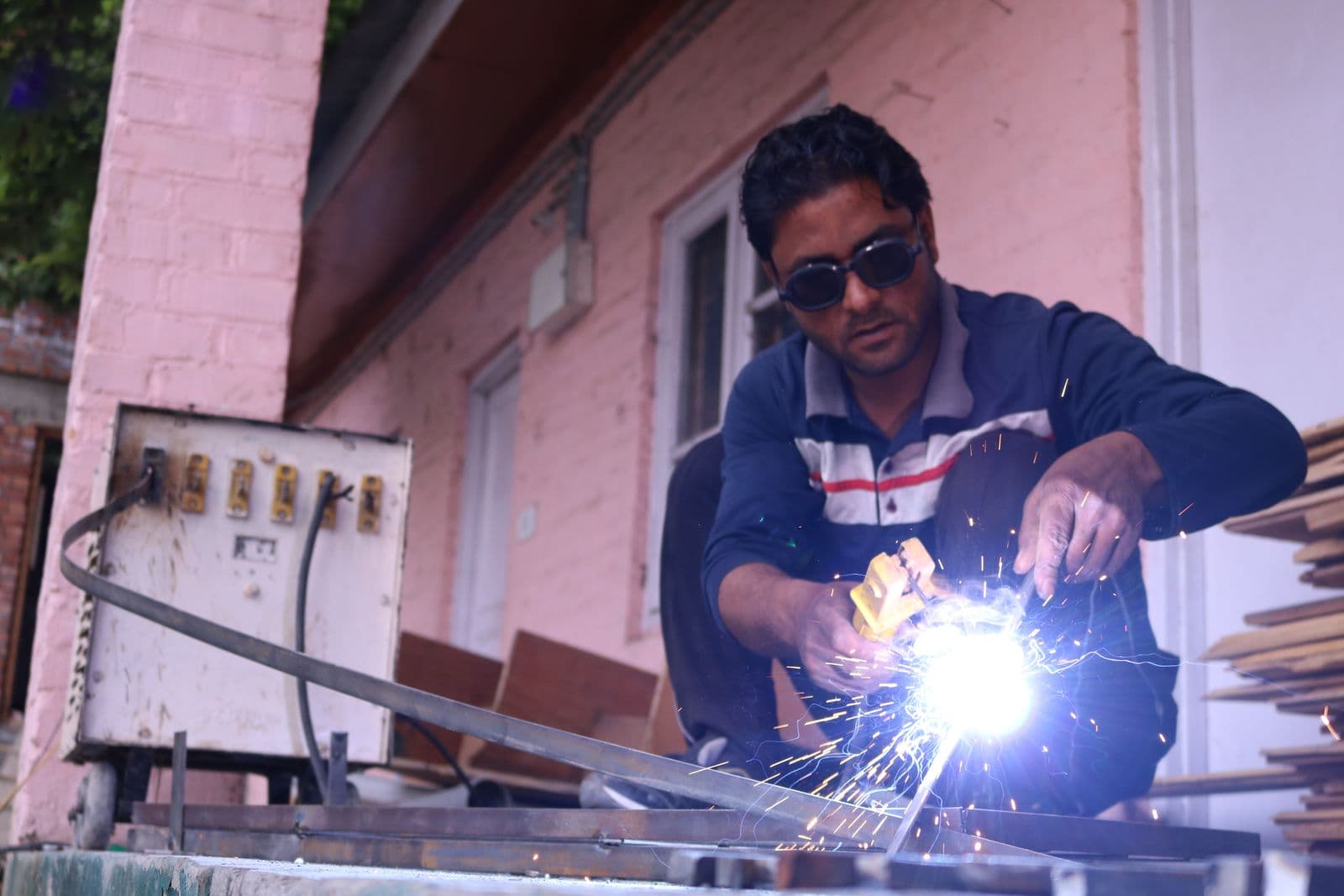
§1What this business is
A job shop that bids for work from engineering drawings and turns CR carbon steel, stainless steel and other sheets into parts and assemblies. Sheets are cut on shears or laser/plasma machines, punched, bent on a press brake, rolled, joined by spot and seam welding, then sand-blasted, pickled and powder-coated. Buyers are vehicle and white-goods makers, electrical panel builders, machinery makers, material-handling and mining equipment firms, and furniture and building contractors.
Capacity: 350 MT of sheet-metal parts a year; year 1 at 40%.
§2Is it right for you?
Who it is for
An ITI, diploma or graduate with fabrication experience and contacts among manufacturers.
Who it is not for
Someone without engineering-drawing skills or a buyer pipeline to keep the machines busy.
Advantages
- Serves many industries, so you are not tied to one buyer
- Value-added work — parts sell at ₹40–150 a kg against carbon steel at ₹30–60 a kg
- Repeat orders once you are an approved vendor
- Export scope for precision parts, per the profile
Drawbacks
- Machines are costly — ₹68.15 L
- Loss in the first year in the profile
- Job-shop work is irregular and price-driven
- Buyers demand tight tolerances and on-time delivery
Skills you need
- Reading drawings and estimating jobs
- CNC cutting and press-brake bending
- Welding and surface finishing
- Vendor registration and quality systems
Why difficulty 4/5: Heavy machinery cost and you must keep winning job orders.
§3Market
Who buys
- Automobile and heavy-vehicle makers
- White-goods and electronics makers (chassis, casings)
- Electrical control panel builders (cable trays, enclosures)
- Machinery, material-handling and mining equipment makers
How it sells
- Direct job orders against drawings
- Approved-vendor contracts with manufacturers
Good to know
- The profile sees export scope for precision sheet-metal parts in electrical and electronic uses.
- Sale prices range from ₹40 to ₹150 a kg depending on metal and work.
§4Raw material & machinery
| Item | Qty | Cost |
|---|---|---|
| Sheet shearing machine | 1 | ₹2,00,000 |
| Laser / plasma profile cutting machine | 2 | ₹8,00,000 each |
| Hydraulic press brake | 1 | ₹4,50,000 |
| Hydraulic press | 2 | ₹8,50,000 each |
| Mechanical power press | 1 | ₹2,50,000 |
| Manual shearing press | 3 | ₹40,000 each |
| Manual sheet folding machine | 2 | ₹45,000 each |
| Fly press | 3 | ₹35,000 each |
| Spot and seam welding machine | 4 | ₹80,000 each |
| Profile rolling machine | 2 | ₹3,50,000 each |
| Beading and curling machine | 1 | ₹1,20,000 |
| Sand blasting machine | 1 | ₹2,00,000 |
| Pickling and surface treatment set-up | 1 | ₹2,00,000 |
| Spray / powder paint shop | 1 | ₹2,50,000 |
| Paint baking oven | 1 | ₹2,00,000 |
From: SIDBI Stand-Up Mitra project profile — Sheet Metal Fabrication (2018) — private guide — confirm locally
- CR carbon steel sheets, angles and sections₹30–60 a kg in the profile
- Stainless steel sheets₹150–230 a kg in the profile
- Welding wire, electrodes, flux and fastenersfor joining
- Surface treatment chemicals and paint powderfor pickling, passivation and coating
From: SIDBI Stand-Up Mitra project profile — Sheet Metal Fabrication (2018) — private guide — confirm locally
Suppliers in Building Business Bazaar
Indo German Tool Room, Aurangabad · Chhatrapati Sambhajinagar →Central Tool Room, Ludhiana · Ludhiana →Central Institute of Tool Design, Hyderabad · Hyderabad →Central Tool Room & Training Centre (CTTC), Kolkata · Kolkata →Central Tool Room & Training Centre, Bhubaneswar · Bhubaneswar →Indo Danish Tool Room, Jamshedpur · Jamshedpur →Tool Room & Training Centre, Guwahati · Guwahati →MSME Technology Centre, Bhiwadi · Bhiwadi →MSME Technology Centre, Pudi, Vizag · Visakhapatnam →MSME Technology Centre, Bhopal · Bhopal →MSME Technology Centre, Rohtak · Rohtak →MSME Technology Centre, Kanpur · Kanpur →
§5Licences & registration
- Udyam registration
- GST registration
- State Pollution Control Board consent (painting, pickling, sand blasting)
- Factory licence
- Fire safety clearance
- Vendor registration with buyers; ISO 9001 helps win orders
§6Schemes & subsidies
- CGTMSECentralActiveNo collateral, up to ₹10 crore
- Stand-Up IndiaCentralClosed₹10 lakh – ₹1 crore loan
CGTMSE for a loan without collateral; Stand-Up India (₹10 L–₹1 crore) for SC/ST and women founders. The ₹137.33 L cost is above PMEGP's ₹50 L ceiling.
§7Money
How the investment is worked out: Land ₹15.00 L + building ₹30.00 L + plant and machinery ₹68.15 L + fixtures and electrical installation ₹3.70 L + preliminary and pre-operative ₹1.50 L + margin for working capital ₹18.98 L = ₹137.33 L.
Working capital: Working capital ₹40.81 L gross (stocks ₹11.09 L, receivables ₹10.12 L, overheads ₹4.43 L, creditors ₹15.18 L); margin ₹18.98 L, bank ₹21.83 L. Finance: owner ₹48.57 L, loan ₹88.76 L.
SIDBI Stand-Up Mitra profile, uploaded in 2018 (no year printed on it) — prices will be higher now; check current costs.
§8Export potential
Confirm the HS code in the DGFT ITC(HS) lookup before you export
Export council / board: EEPC India
- Confirm the 8-digit ITC(HS) line with DGFT or your customs broker before shipping.
- You need an Import Export Code (IEC) from DGFT before the first shipment.
§9Risks — where people fail
- Idle machines between orders
- Steel price swings on fixed-price jobs
- Rejections for size or finish faults
- Late payment by large customers
§1030 / 60 / 90-day plan
A general plan that applies to any business. A plan for this business will be added after research.
- Days 1–30: Visit a working precision sheet metal fabrication (job shop) unit, ask 10 buyers about price and quantity, and get quotations from 3 suppliers.
- Days 31–60: Udyam and the licences you need (Udyam registration, GST registration), a project report (DPR), and the scheme or loan file.
- Days 61–90: Space and machines, trial production, and first deliveries to 10 customers.
§11Who to connect with
Associations, clusters and training institutes — the directory is being built. Connect
§12Watch
There is no episode on this business yet. Shows are coming soon on the Podcast page.
Want to start Precision Sheet Metal Fabrication (Job Shop)?
DPR, loan file or registration — ask us on WhatsApp.
¶Sources
Data review: 6 October 2026. Spotted a mistake? Report it. For information only — not legal or financial advice.